


Setting Out for Mykines
A Swedish painter, a Danish dentist, and a Faroese captain board a ship. What sounds like the beginning of a joke was, in fact, a scene that played out one Sunday morning in 1924, in the harbour of Tórshavn.
Clad in raincoats, wellies, and sou’westers, five sportsmen set out into a rough sea with a crew of three Faroese seamen. Their destination was Mykines, the westernmost island of the Faroe Islands.
As the boat entered the current between Nólsoy and Streymoy, the artist took position at the bow. Instead of a brush he carried a rifle.
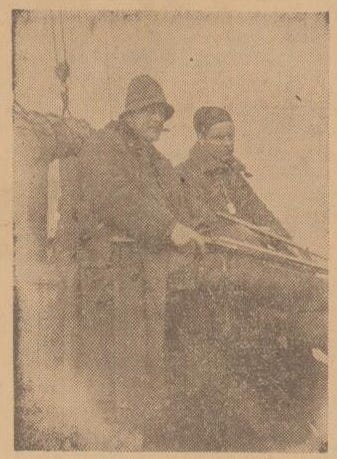
Knud Johannes Rohmann had joined the Swedish painter-hunter that day as he attempted to cross over to Mykines. Unlike Gislander, he had not come to the Faroes to paint birds, cliffs, or storm-torn seas: Rohmann had come to pull teeth.
I first encountered the Danish dentist through the provenance of a work by Gislander – a painting of Eider ducks that Rohmann had purchased while still on the islands. It was the first Gislander work whose trail I followed into a private collection.

Only later did I discover that Rohmann left behind more than the painting: a series of letters printed in Danish newspapers – some of them tracing journeys alongside the Swedish painter.
Gloomy Outlooks
“The first impression one gets of the town – and of the country, as well – is rather bleak.” 1
On 23 April, the first letter by Rohmann appeared in Silkeborg Avis, the newspaper of his home region. At the time he wrote it, on 8 April 1924, the dentist had left his home in Kjellerup behind already for a few weeks. From the middle of March onward, local newspapers advertised his services in Tórshavn:
K.J. Rohmann, modern and painless treatment.2
In the opening lines of his first letter from the Faroes, Rohmann paints a disenchanting picture of the islands. He disembarked in a harbour assailed by the elements, protected by little more than the ridge of Nólsoy on the other side. Smoke belches from the ships whose engines remain on stand-by in the harbour, always ready to escape another onslaught of rain and gales that loom over the islands.
The houses spread out irregularly in the historical part of the town, Rohmann writes, home to some 2,500 inhabitants. The hygienic conditions the dentist found appalling: open channels, he complained, flush black water into the sea. Chickens and ducks wander randomly in the streets. Often, those who return late at night even stumble over flocks of sheep.
In the upper part of the town, he concedes, there is at least electricity. Yet much on the islands is still behind. In total, there are only two or three cars on the islands. Anywhere outside of the city, their services are useless, in a landscape that has neither roads nor trees.
South Along Cliffs and Caves
It was a harsh environment to which K. J. Rohmann arrived in early 1924, bringing dental services to the seventeen islands in the North Atlantic. Yet the harsh environment held space for adventures, too.
In early May, Rohmann sent a further letter to Denmark. In the text entitled “Around the Faroes in Fog and Storm”, he describes the break-neck boat tour he undertook “with the lads” to Mykines.3
The lads, as he continues, are a crew of three Faroese seamen that the artist Gislander had gathered around him – a painter who had taken up residence in this “Eldorado of birds” to depict them in these landscapes.
Rohmann lets his acquaintance and travel companion appear in flattering light: he is a member of the Swedish Academy, the dentist praises, has exhibited at Charlottenborg, and will show the magnificent paintings from his stay in an exhibition at Copenhagen, together with the artist Ring.
While Rohmann overstates the painter’s actual merits,4 it seems he took pride in being invited together with four other ‘sportsmen’ as companion for the boat trip. To cross over to Mykines, he writes, Gislander had chosen the fourth of May, to reach the island before the great migrations of birds set in.
We do not know whether Gislander drew or painted on the boat trip Rohmann describes. However, motifs in paintings by him known so far relate to sceneries and encounters with wildlife as the dentist described them in the letter tracing the route to Mykines.
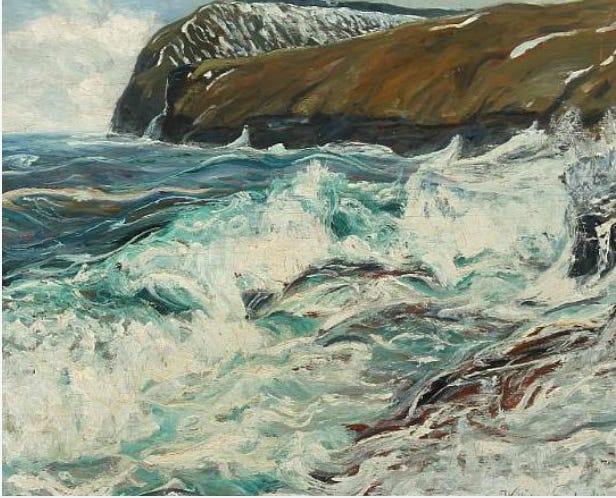
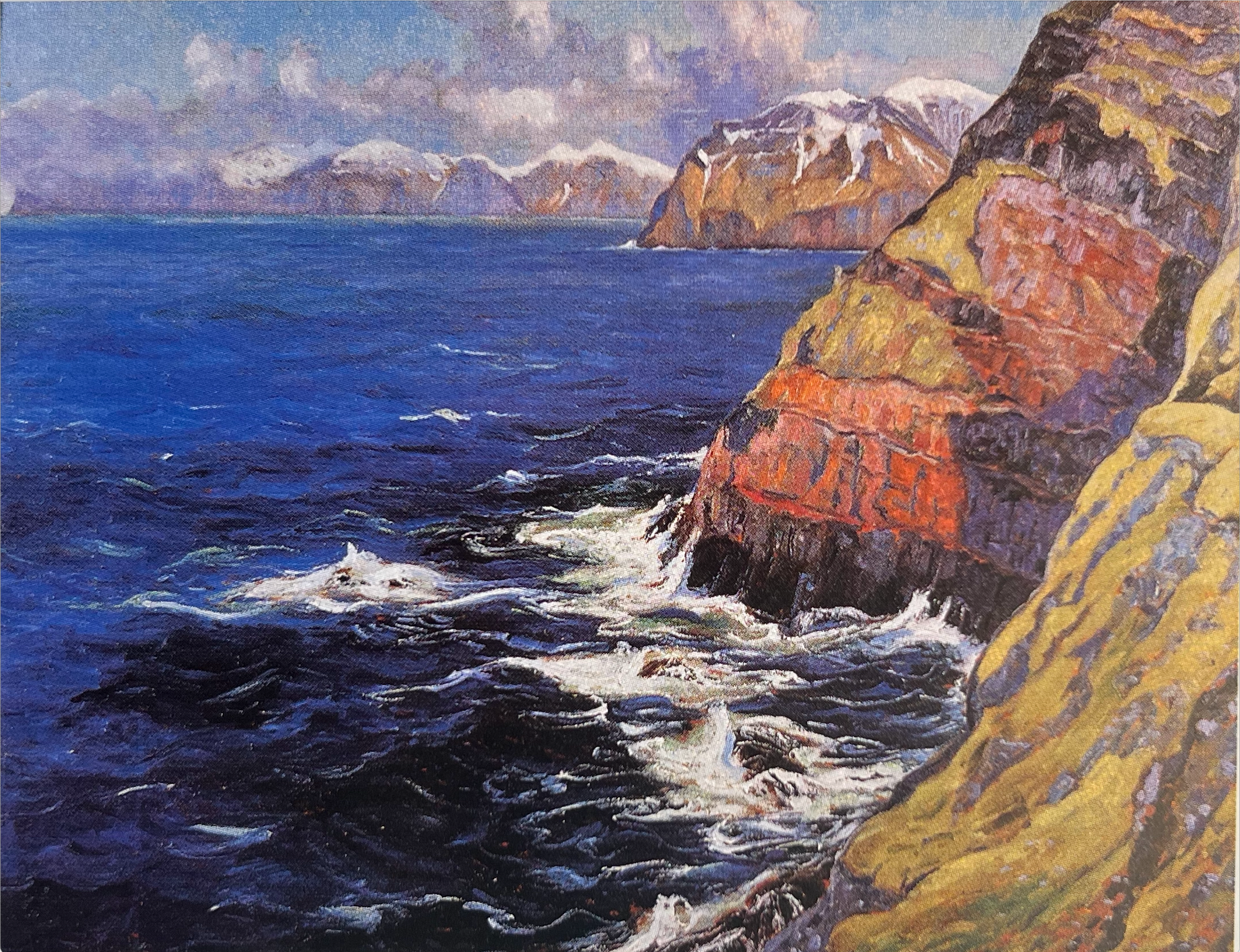
Having passed the peninsula at Glyvursnes, their boat continued skimming along the coastline. Surf splashed against the cliffs in white foam, revealing magnificent shades of green in the sea. Travelling south, the crew passed the caves accessible only from the seaside.
Inside, rays of mist-dimmed sun elicited colours of all kinds in the waves that struck the rocks with deafening noise.5 Nearby the caves lie the breeding places of the seals, Rohmann writes. Above, on inaccessible ledges, reside black cormorants – birds that, as he points out, always hunt in pairs.
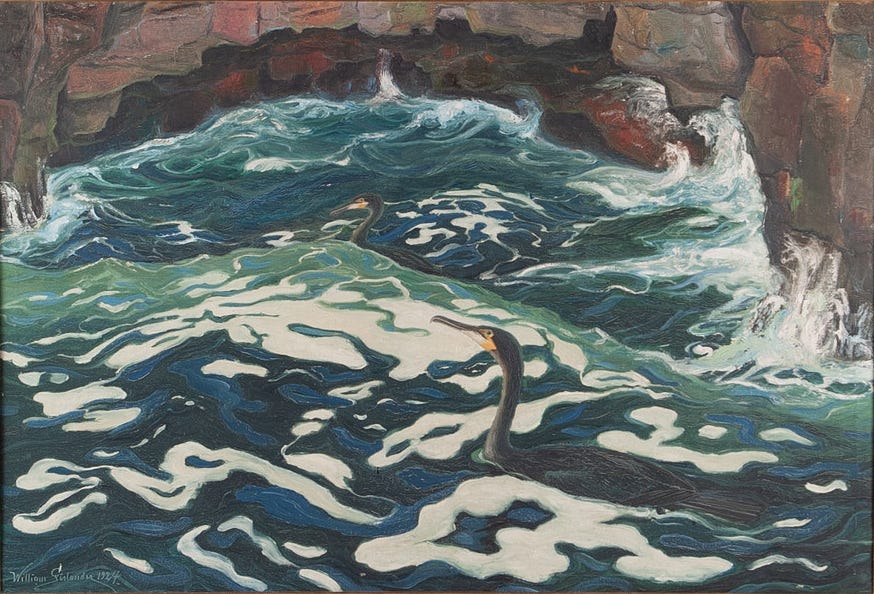
Several of such pairs appear in paintings by Gislander. In one of them, a pair floats on crests of translucent green as the waves surge into a cave (see above).
A further pair is seen overlooking the sea from a skerry (see no. 20 in the Search List), while another appears floating on the sea as mist reveals the silhouette of Hestur – the view that opened after rounding Kirkebønæs.
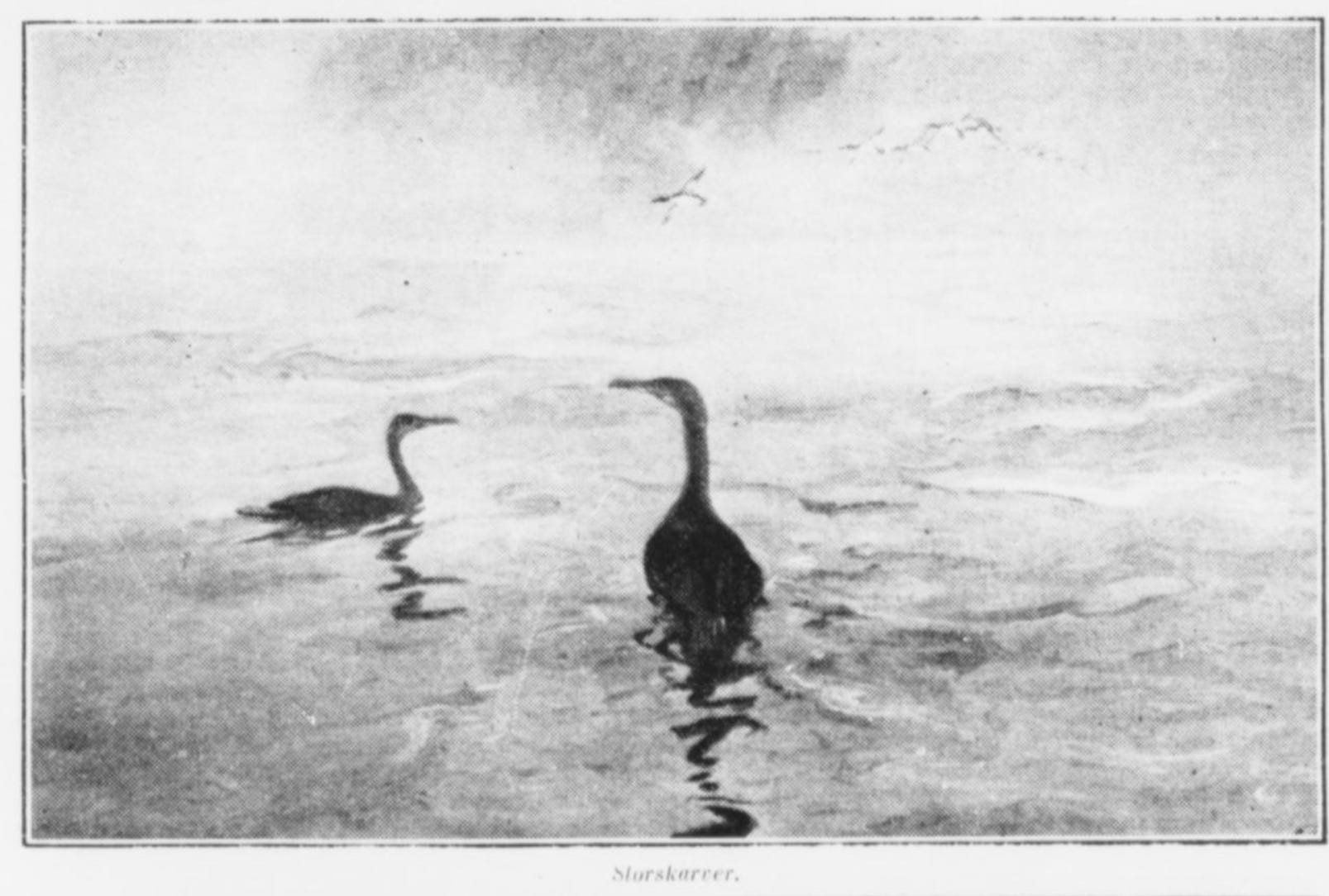
On the cliffs above this southernmost tip of the main island, Rohmann writes, they spotted the black cormorants again.
Eventually, one of them succumbed to the drumfire opened by the riflemen at the bow (perhaps, it later served as a model in the atelier at Tórshavn where Gislander carried out his works?).
Veðurføst
Passing by the islands of Hestur and Koltur, the boat set course towards the west.
On the horizon, rugged tops emerged from a storm-tossed sea; the tip of a gigantic mountain whose base continues deep beneath the sea. The island of Mykines came into sight.
Eventually, however, the elements won. Facing towering waves and storms, the sailors advised to abort the crossing.
There is a Faroese word for this condition of island life: veðurføst – “stuck by weather”. Sailing into the fjord of Sørvágur, the boat found shelter among the steep cliffs.
Here, on the island of Vágar, the ‘lads’ dropped off Gislander. The crew decided to round the island and return to Tórshavn, where their adventure became the talk of the town.
Weather conditions brought William Gislander an unexpected sojourn on Vágar. With the next post boat, Rohmann writes, the artist would continue his journey to Mykines.
Yet this stay, even if forced, would not be to his disadvantage, the dentist assured his readers: “Magnificent works Gislander will paint here” – with that thought, their paths parted.
Pulling Teeth on Mykines
In a month’s time, Rohmann writes still in the same letter, he would attempt the crossing to Mykines again.
The next time, weather conditions did not bar the dentist from reaching the island. On 29 May 1924, as Rohmann writes in another letter, he disembarked at the landing site below the village.6
In deep awe, he had made the final approach to Mykines: the force of the waves lashing its perpendicular cliffs, the innumerable birds nesting there each year, the verdant grass that covered the island at this time of the year.
Of the 137 people living on Mykines, Rohmann writes, no fewer than sixteen pain-ridden villagers rejoiced at the sight of his extraction forceps.
Here, the dentist reunited with William Gislander. The artist had already spent some time on the island since he crossed over from Vágar, and as Rohmann writes, “has painted magnificent paintings from this place”.7
Together with the painter, Rohmann went on an excursion to the westernmost tongue of land on Mykineshólmur. Puffins scurried near the bird cliffs they passed. From one of their holes, Gislander pulled out one of these avian fellows in its monastic habit (an early pictorial study of these birds today is kept by the National Gallery of the Faroe Islands).
At the utmost tip of the island, they reached the colony of gannets. Beneath the cries of these birds and the sound of their wingtips cutting the air, they listened to the lore the villagers told of the ‘King of the Gannets’ – the castaway albatross from the southern hemisphere that joined these birds half a century before.
The Hidden Camera
Two further letters exist by the travelling dentist, printed back in Silkeborg in 1924. One of them describes a hiking excursion with four others that he undertook in the mountains north-west of Tórshavn. In the last of the letters that Rohmann sent in June, he continued his “dentist tour” to Suðuroy, the southernmost of the islands.8
Yet it seems there was more material from his stay on the Faroes than these articles.
“I have enclosed photos of the drying places and the work of the fishermen,” Rohmann wrote that summer from Suðuroy.
This detail connects with hints he left in other letters: among the luggage for his hiking tour near Tórshavn, Rohmann mentioned not only the lunch packs, but also cameras.9 And after weather had forced him to abort the crossing to Mykines in early May, the dentist concluded:
”In about a month, we’ll make the same trip again and hope for fair wind and sunshine, so that the camera will be usable.” 10
Did Rohmann leave behind a trail of forgotten photographs from the Faroes?
Let that be material for another story.
Further Readings and References
All translations are my own unless stated otherwise.
For his support of my archival studies I am grateful to Christoph Klinger.
[K. J.] Rohmann, “Mod Nord!”, Silkeborg Avis, 23.04.1924, p. 1.
See e.g. Dimmalætting, 15.03.1924, p. 1.
K. J. Rohmann, “Rundt om Færøerne i Taage og Storm”, Silkeborg Avis, 19.05.1924, pp. 1f.
A brief fact check: Gislander was certainly no member of the Swedish academy. For his exhibiting at Charlottenborg I have so far found no evidence. Later in 1924, Gislander exhibited at Den Frie in parallel to an exhibition by Ring, but certainly not “with” Ring in the sense of an exhibition endorsed by the members of Den Frie. Gislander simply rented exhibition space. However, also interviews given in the 1930s, Gislander continued to use the ambiguity of this formulation to his advantage.
Rohmann also remembers the vast caves and colours of “Geivovsnæs” in a later letter that describes the passage from Tórshavn to Suðuroy; see K. J. Rohmann, “Fra Færøerne.”, Silkeborg Avis, 6.08.1924, pp. 1f., here p. 1.
K. J. Rohmann, “Myggenæs.”, Silkeborg Avis, 16.06.1924, pp. 1f.
Rohmann, “Rundt om Færøerne i Taage og Storm”, p. 2.
Rohmann, “Fra Færøerne.”.
[K. J.] Rohmann, “En besværlig Fjeldtur.”, Silkeborg Avis, 11.06.1924, p. 1.
K. J. Rohmann, “Myggenæs.”, p. 2.