


Sunday, 21:51
“”Far out in a radiant ocean glinting like quicksilver there lies a solitary little lead-coloured land. The tiny rocky shore is to the vast ocean just about the same as a grain of sand to the floor of a dance hall. But seen beneath a magnifying glass, this grain of sand is nevertheless a whole world with mountains and valleys, sounds and fjords and houses with small people.”
William Heinesen, The Lost Musicians1
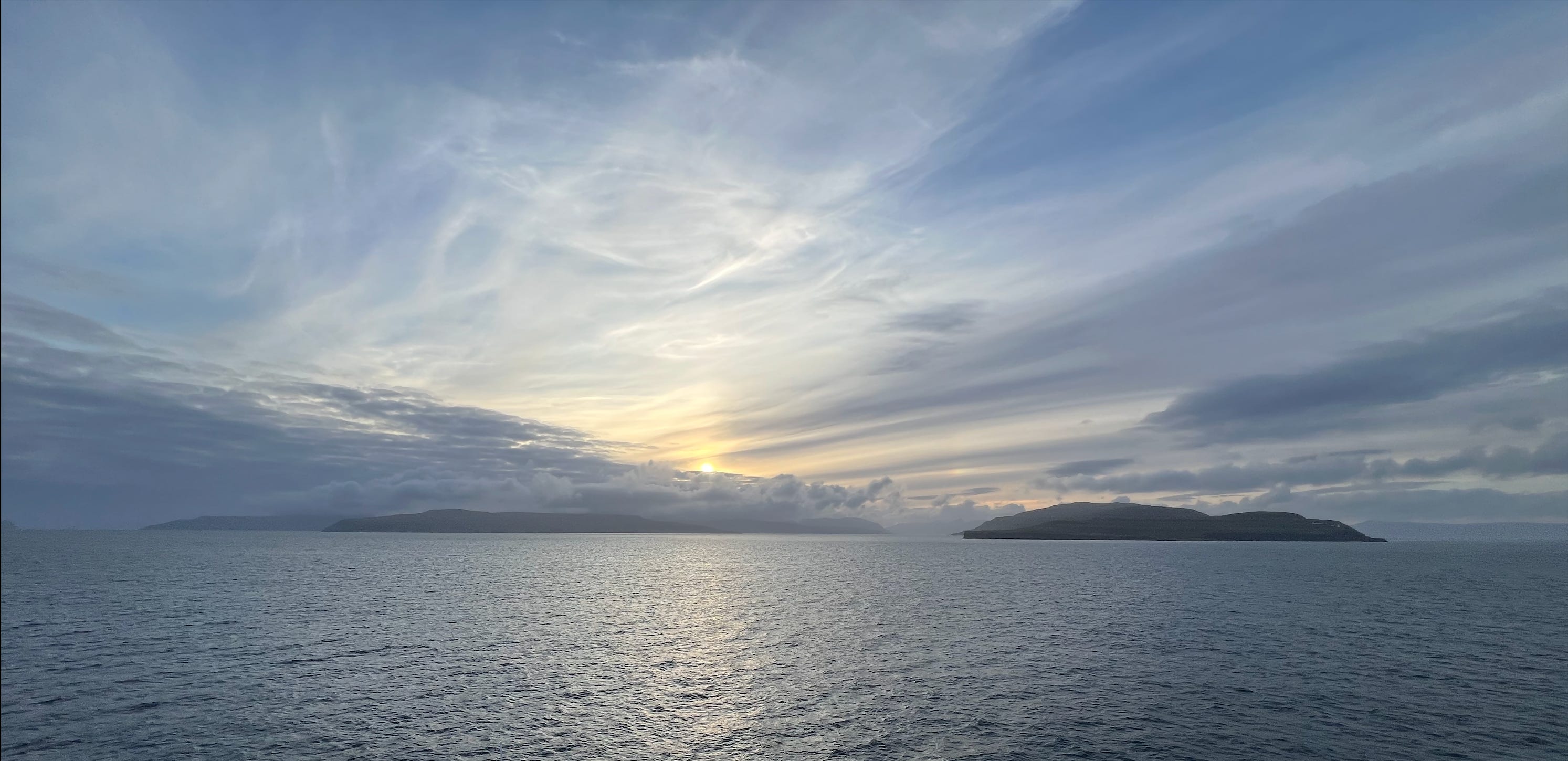
The opening lines by the novelist William Heinesen cross my mind as the main island comes into sight. It is two hours to midnight and the sun is just about to sink into the clouds above the largest of the Faroe Islands.
From my backpack I take a pair of opera glasses that have travelled with me since my years in Italy. Instead of the frescoes high up in church naves, I trace the southern side of Nólsoy, its contours stacked into a silhouette softened by mist and distance, resting upon a sheet of pewter water.
Heinesen, Blake, Gislander – a train of thought shuttles between a triumvirate sharing the same first name as we enter the Fjord of Nólsoy, until it derails by the loudspeaker’s crackle:
Disembarkment at Tórshavn in one hour.
Sunday, 23:30
I remember your face from the museum website …
Zacharias Heinesen walks down the path from his house. The artist is in his nineties, and recently Listasavn – the National Gallery of the Faroe Islands – celebrated him with an exhibition.
It is late and only briefly, I hint at my work to retrace the footsteps of the Swedish painter William Gislander. “Yes, I still paint,” Zacharias tells me as he hands over the key.
“Let’s talk more during the week”, he says as he ascends the slope again where his home and atelier lie.
Key in hand, I stand in front of the stairs to the house where I had pushed my bike up from the harbour. The sidings are painted red, in a brighter tone than the Swedish cousins. The roof and the doors, the railings and window frames – they shine as turquoise highlights on the chili ground.
His father William built the house in the 1930s. Today, the Heinesen family maintains it as a museum in his honour, offering the top floor as a residence to artists and writers.
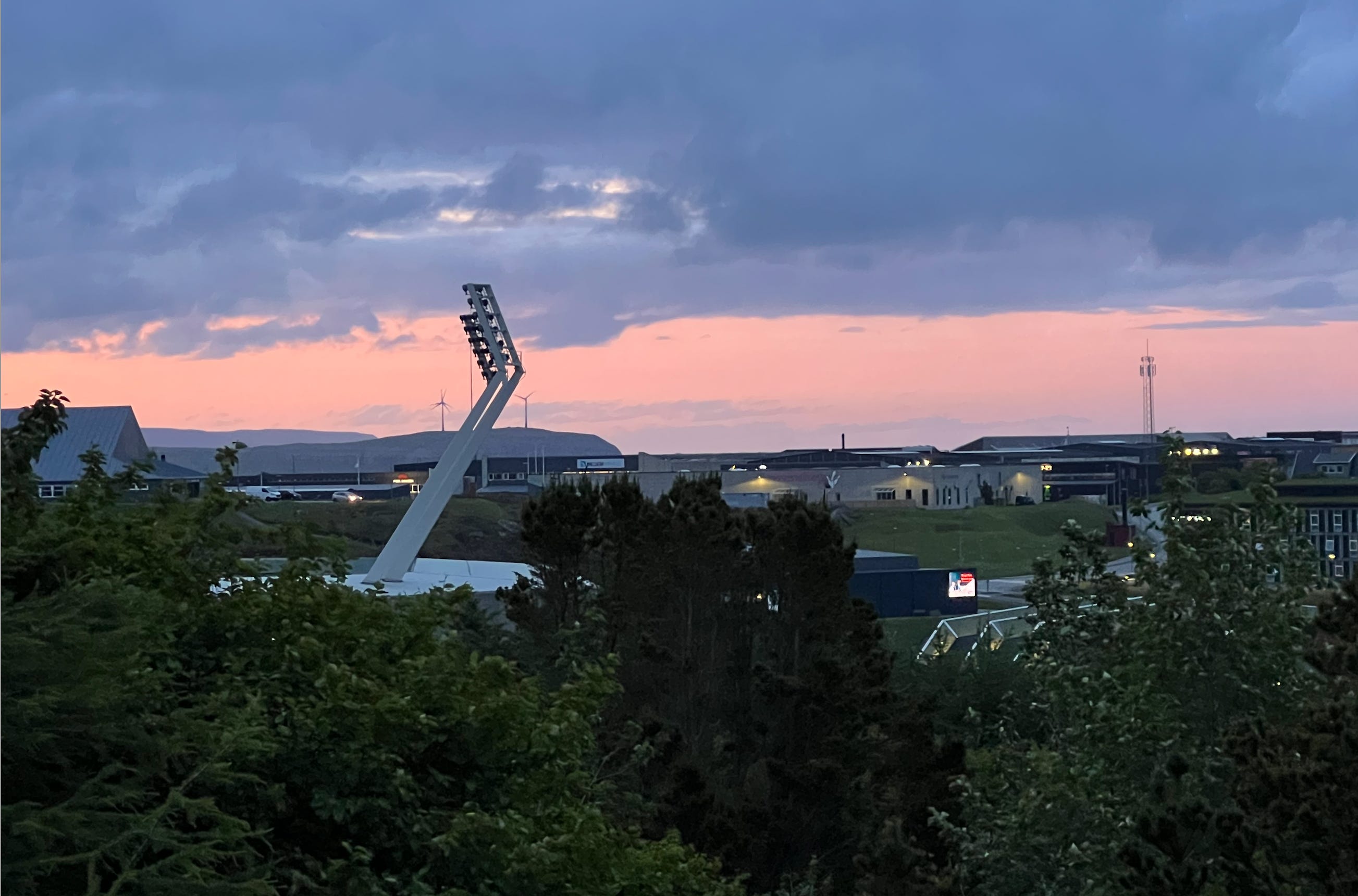
From the bathroom window upstairs, I spot a first glimpse of a landscape from the paintings I came to study. Past the floodlights of the football pitch, I see the headlands of Eystnes protruding across a horizon painted by dusk.
Through the turquoise window grids of the living room, I spot another motif. The ridge of Nólsoy, the background of several Gislander paintings. As my gaze wanders across its outline, I think of the famous illustration by Saint-Exupery, the elephant swallowed inside a boa constrictor.
A seagull lands on the streetlight in front of me. Briefly, our eyes lock, before the midnight visitor departs again, across the treetops of the municipal park, into a night that knows no dark.
Monday, 7:53
I return to the window, sleeping mask still in hand.
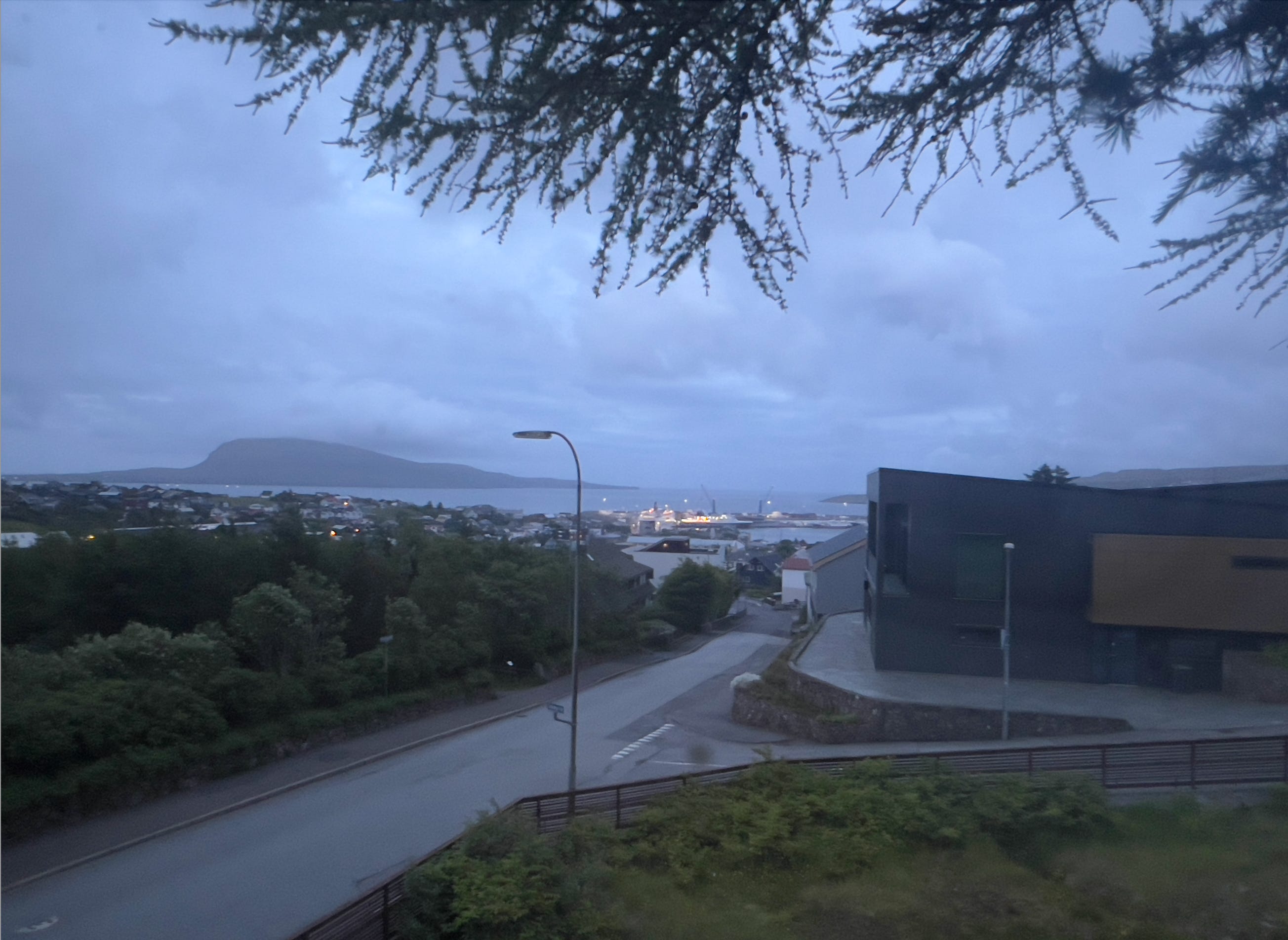
Last rags of mist are dissolving Nólsoy. With it disappears yesterday’s association. The ridge now stands sharp against the morning sky, its structure laid bare.
The ship on which I came is out on the sea again, leaving behind a void in the harbour basin.
Until the kettle boils, I watch the wind play in the tree tops of Tórshavn.
Monday, 10:02
Plantasjan is one of the names by which the Faroese call the park – ‘the Plantation’.
The stroll from my residence towards the National Gallery winds along trees brought together from across the world. Above the old town, they form the only forest on eighteen treeless islands.
Among them thrive varieties of Nothofagus that were transplanted here half a century ago, by a Danish expedition sent out to Tierra del Fuego – the same place where my trace towards Sámal Joensen Mikines and William Gislander begins.
Monday, 11:16
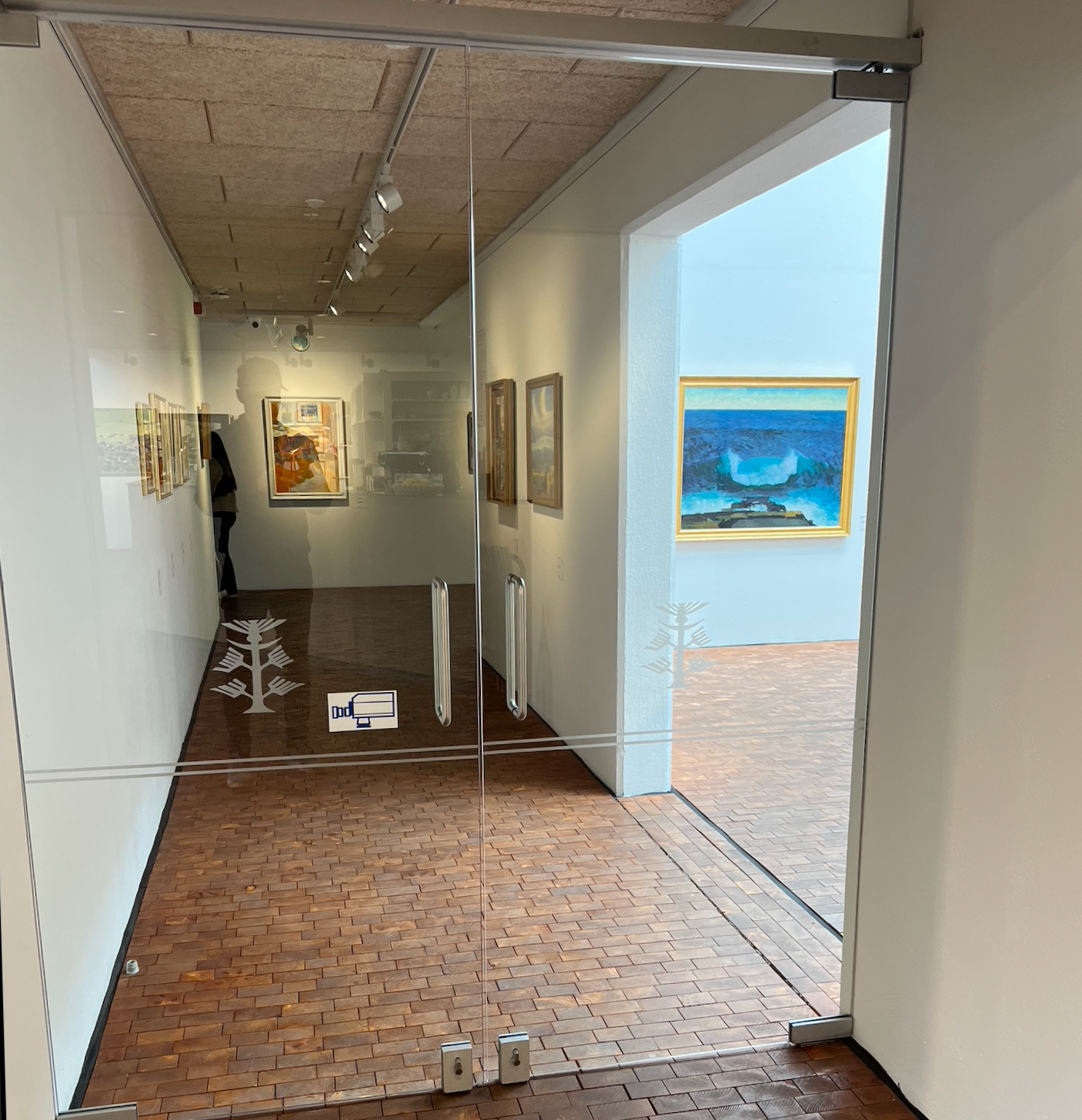
The first painting I see at Listasavn is a breaking wave.
Through the door to the exhibition space, I see the turquoise of a bulging barrel of water pierce through the glass in its glacial shade.
It is another version of a work that I had seen a month before, when I visited the Mikines family in Copenhagen. Eirikur and Birgir made me spot the same wave in a number of paintings that I showed them by Gislander.
As it turned out, he, too, had painted the waters breaking at the landing site of Mykines – from the same spot which later also Sámal Joensen-Mikines sought out to paint.
Monday, 13:09
From the first meeting with my new colleagues, Anna Maria and Solveig, I leave with an A4 page full of notes, straight into the exhibition.
Through the glass door, I spot Solveig again in the lobby. I wave her over, eager to share what I had learned about the wave at Mykines the month before.
I find her alive to the story of the waves by Gislander; of his marine views that inspired the early motifs of Joensen-Mikines, too. From the wall next to the painting she picks a smaller frame. It is the earliest one by Joensen-Mikines in the room, a coastal view from Vágar.
Carefully, Solveig turns it around to reveal the back of the painted surface.
The sides of tea boxes, the owners who donated this work to Listasavn still knew.


Having just entered the exhibition space, I already feel one step closer to the years when the young Sámal Joensen-Mikines had just met the Swede William Gislander on Mykines, and to that summer in 1924 when he scraped rests from metal tubes and began to paint on pieces of scrap wood he could find in the village.
One room. Two paintings. The first twelve hours.
The journey had just begun.
This work was produced with the financial assistance of the European Union. The views expressed herein can in no way be taken to reflect the official opinion of the European Union.

References
William Heinesen, The Lost Musicians, transl. by W. Glyn Jones, Cambs 2006, p. 15.