


“You’re up against a strong force,” one visitor pointed out: “good weather on the Faroe Islands!”
The words were meant as encouragement – despite sunshine outside, the lobby of Listasavn had filled with people for the Sunday afternoon lecture.
Among the audience at the National Gallery there were a few familiar faces: people with whom I had connected during my first week on the islands, and even before– the artist Ole Wich, the bird expert Sjúrður Hammer, and also Bárður Jákupsson, a central figure in Faroese art history.
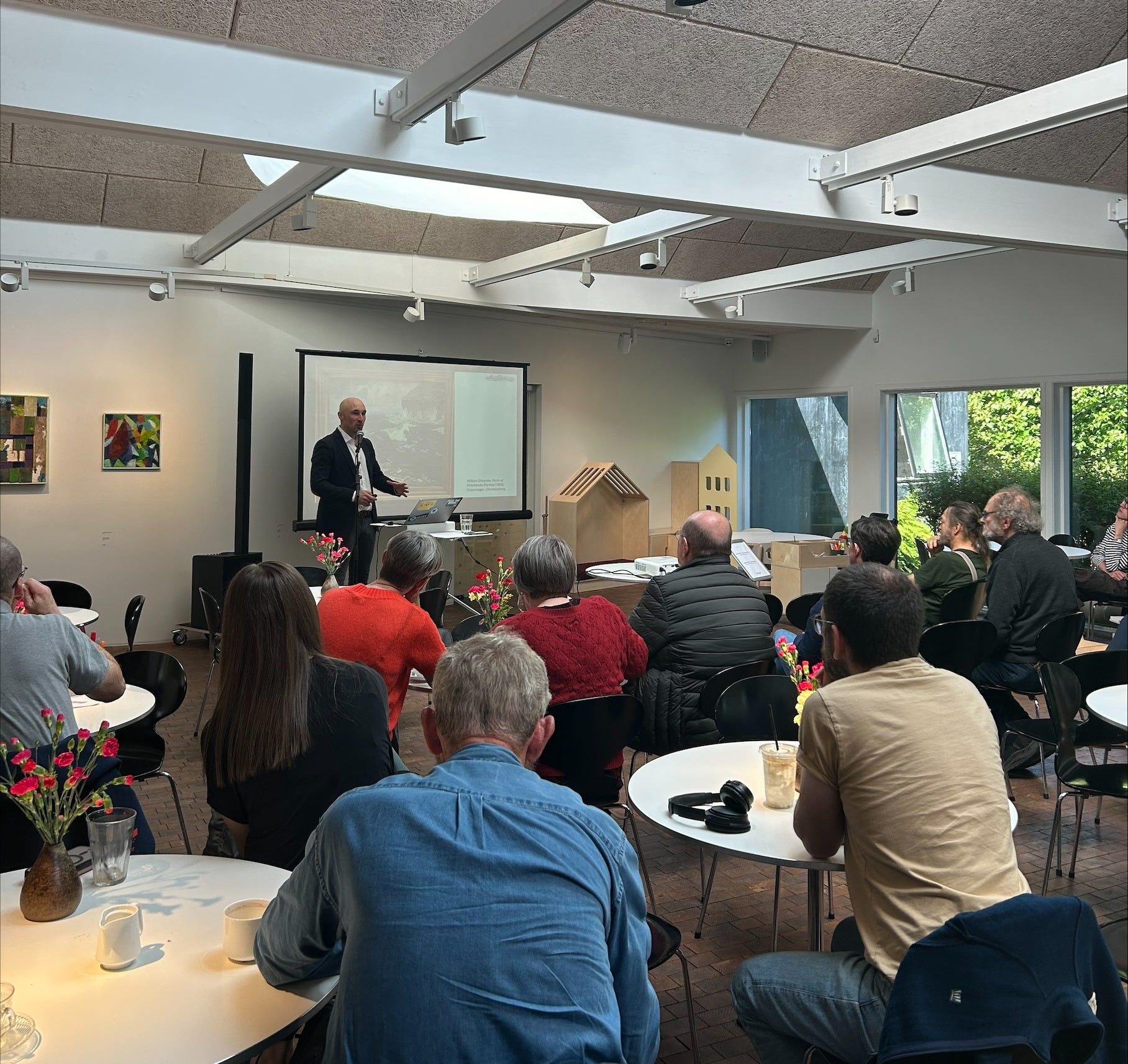
Visitors had travelled from as far as the westernmost parts of the Faroes – Eirikur, relative of the painter whom I had met at the Mikines family home in Copenhagen, his wife Mia, and Oda, who has lived on Mykines for many years and still guides there.
Over the course of an hour, William Gislander and his scattered paintings took the stage. I traced the path that led the Swedish painter to the Faroes, and the roughly one hundred paintings he made during his stay.
Two originals were also on site and presented after the lecture: a puffin study from the collection of Listasavn, and a view from the Northern Islands from the collection of the Føroya Banki, personally brought in a few days earlier by Helgi Fossdal.
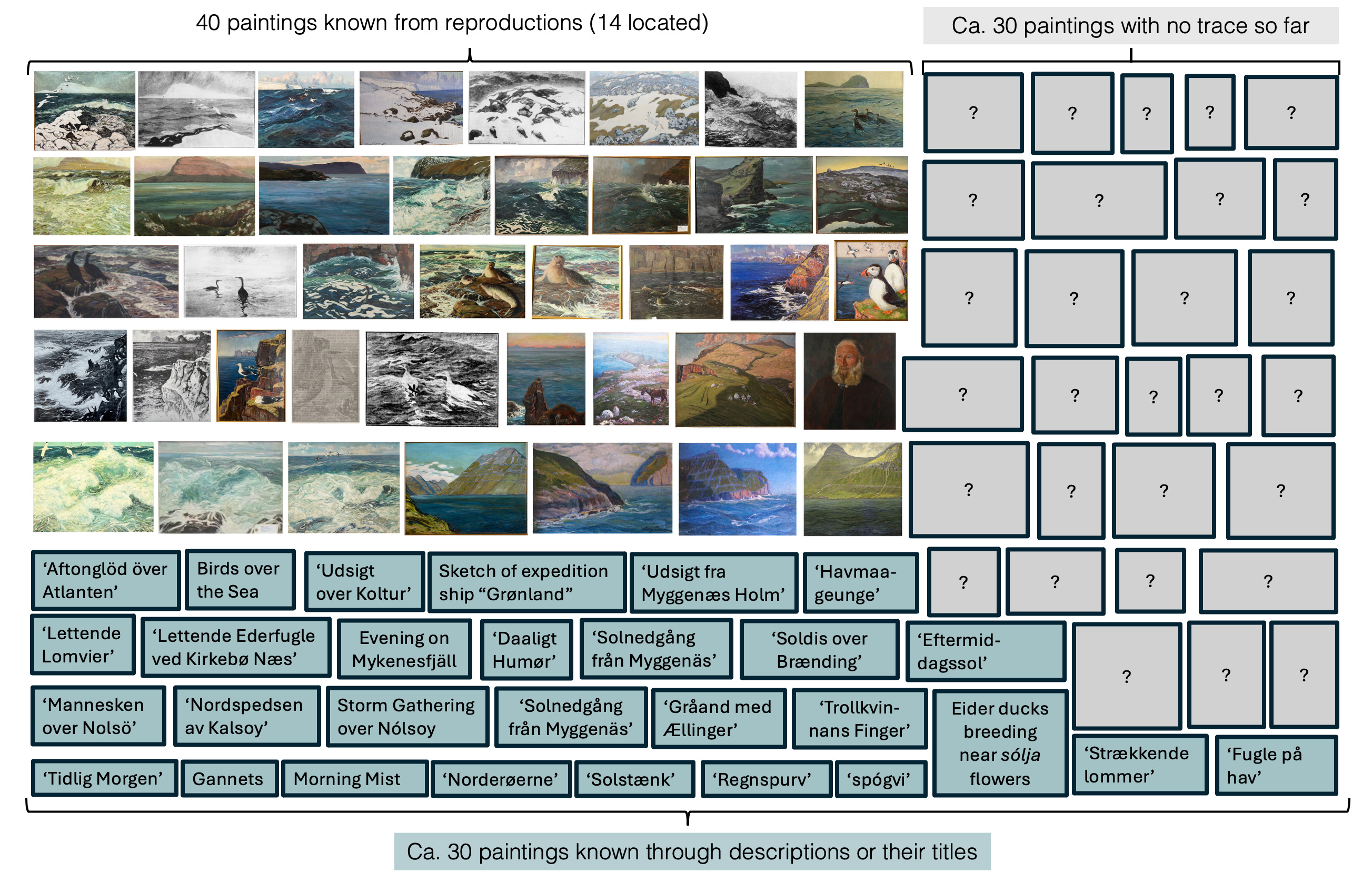
The hope shared by Listasavn and me was that a radio interview and a lecture early in my stay might help spread the word about the ongoing search for paintings, and gather insights and leads from the audience.
The plan seemed to work.
“You showed several paintings with the great cormorant,” Sjúrður said afterwards. “On the Faroes, that bird has been extinct since around the middle of the last century,” he pointed out. “These may actually be among the very few paintings showing it in this setting.”
“That coastal view you showed –” another visitor said.
I flipped back through the slides.
“Yes, that one, I think I know where it is” (he later wrote down the correct spelling on a piece of paper).
“Thanks for the talk,” Eirikur said after the talk. “We are going up to the house on Mykines Sunday next week. How long are you staying on the islands?”
“You have to come and visit.”
No single clue solves this puzzle. It is many clues and associations that move the search forward: remembered places, depicted histories, family memories; shared over paintings brought together again after one century.
What had begun as a trail of auction catalogues, newspaper notes, and paintings scattered across private collections had now taken a further step. For an afternoon at Listasavn, Gislander’s Faroe paintings entered public conversation again.
Acknowledgments
Thanks to the team of Listasavn for their help organising and preparing the lecture, and to the audience who generously shared their ideas.
The lecture and this article were produced with the financial assistance of the European Union. The views expressed herein can in no way be taken to reflect the official opinion of the European Union.
