


The Living Room
“Let’s have a look, shall we?”
I followed Hans into his living room. On its wall, a painting opened a window onto the North Atlantic: Eider ducks on a blue-green sea, with the island of Hestur rising in the distance.
“Gislander must have painted this in early summer,” Hans explained. “It’s a female Eider duck,” he continued, pointing to the middle of the painting.
“They breed on land, up in the fjäll,” he continued. “In May, they leave for the journey to the water. That walk, it’s pretty dangerous for the young. They usually lose some ducklings on the way down.”
“The three you can see here are the ones who made it.”
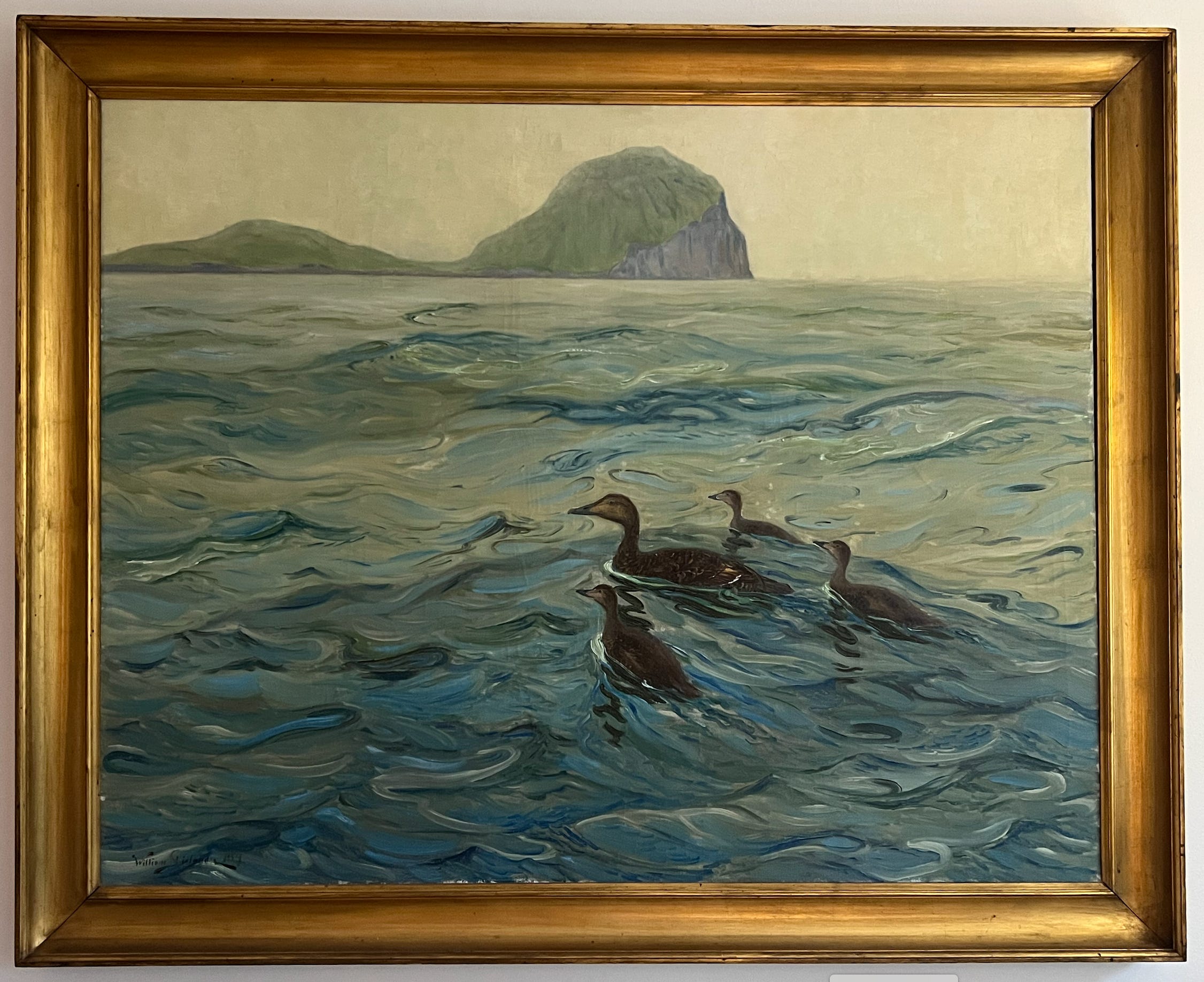
I stepped closer, studying their silhouettes in the water, the reflections beneath, the brush strokes that form the waves.
“There is quite a difference between the paintings by Gislander that I have seen so far,” I said. “How he paints waves. The accuracy he gives to the birds. There’s quite a development across his works from 1924.”
On the screen of my laptop, I shared a few of the reproductions with Hans that I had found so far, together with photographs of paintings I had just seen in the Danish Parliament.
Maybe he was in a bit of a hurry here, we both agreed.
Childhood View with Ducks
I moved back a little again for an overall impression. The colour of the sea shone clearly – differently. Only later did I understand the layers of history this painting carried before it reached this wall.
I had first seen it in a photograph online: the same ducks, the same island, hanging above a dark sofa. During an early search for William Gislander, I found the painting offered for sale only a few months before.
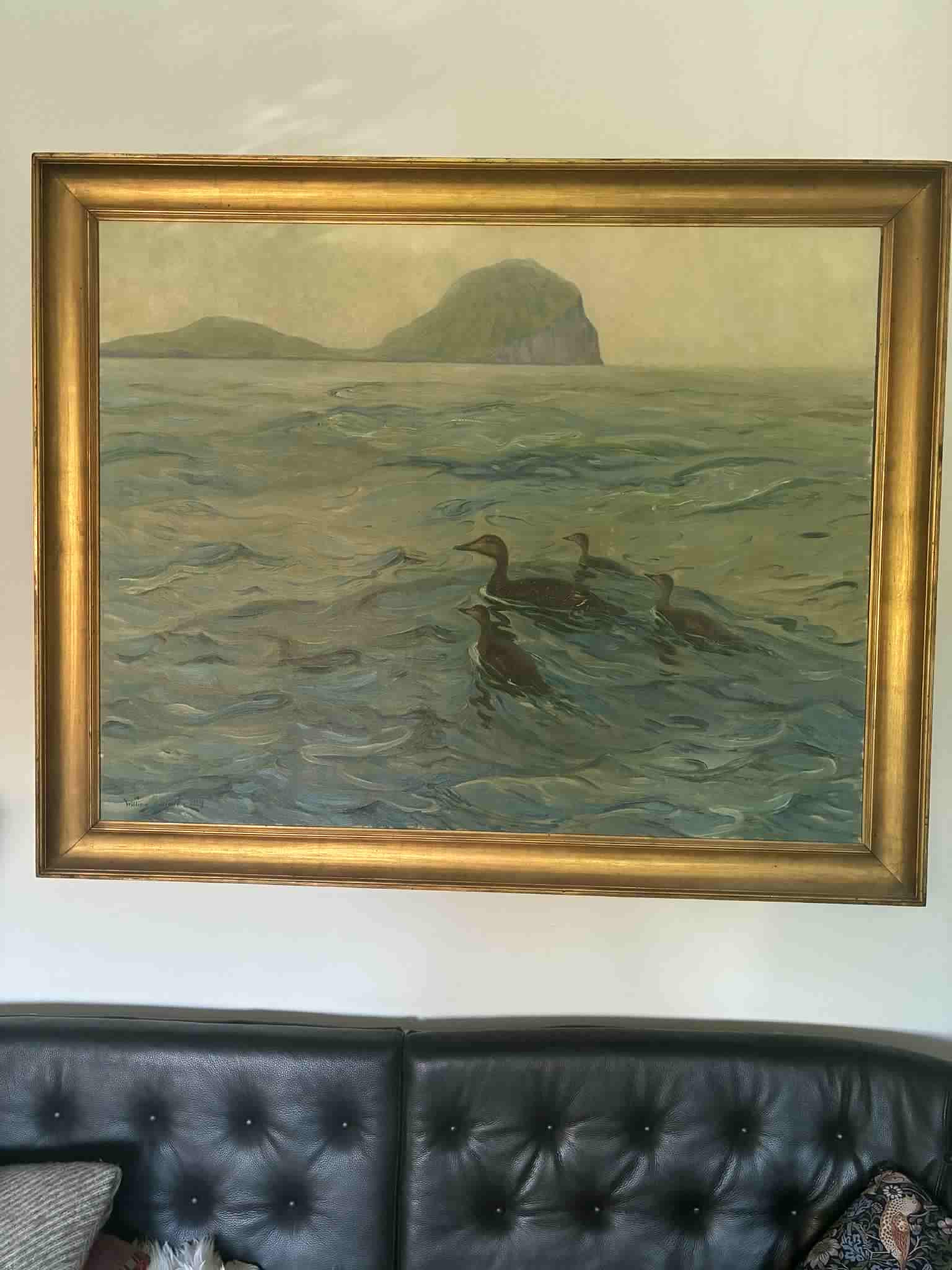
“The painting belonged to my mother,” Lisbet replied to my message. Her mother remembered that it was first brought to Denmark by a Danish dentist.
The dentist worked in the Faroe Islands in 1924, Lisbet continued, at the same time as Gislander. He later lived next door to her great-grandparents, she added. They received the painting from him.
Lisbet was kind enough to forward a contact request to the buyer of the painting.
A week later, I stepped out of a commuter train out of Copenhagen. It was the weeks before Christmas, and beneath a grey sky I followed the narrow bike track snaking between single-storey houses, towards the address Hans had sent me.
We shared a coffee in the kitchen. Hans told me he worked from home, and the kids were at school. In the pauses of our conversation, I listened to the morning quiet of Danish suburbia.
They had moved in recently, Hans told me over coffee. Lisbet had written how happy her mother had been that the painting found a new home – with a family from the Faroes.
“Indeed, I did grow up there,” Hans confirmed. He came from the island west of the main island, from the town of Midvagur. He missed the nature, Hans said. The long walks with the dog, across the ever-changing nature of the islands.
The one on the painting – Hestur – it was the island he saw from his childhood room.
“That’s why I bought the painting, for our place here in Denmark,” he smiled.
“It’s the same ridge – only seen from the other side.”
The Dentist’s Trail
“You know more about the dentist,” I said, “you know, the one who brought the painting back to Denmark?”
“Yeah … I think I read that he was adopted into a Danish family,” Hans said, looking for some records he had followed online before. “They later had the flat above Lisbet’s grandmother’s place. Strong smokers; I had the painting cleaned.”
“There’s this letter I found in the newspapers a few days ago,” I said, “from a dentist who travelled around the islands in 1924. Rohmann I think was his name.”
“Yes, exactly! Rohmann. That’s him.”
Through Rohmann, the Eider ducks had found their way from the Faroe Islands to Denmark. But the dentist had left more than a painting behind.
In May 1924, he had written to his local newspaper from the islands in the Atlantic, mentioning here for the first time “a Swedish painter, Mr. Gislander,” who had taken up residence in what Rohmann called “the Eldorado of birds.”1
Looking at the Eider ducks on Hans’s wall, I saw two trails crossing.
Here was the travelling object, painted by Gislander in the early summer of 1924, which, like the ducklings, had eventually found another Faroese home. And there were the letters the dentist had sent from his journeys on the islands – documents in which new parts of Gislander’s travels across the Faroes were waiting to be discovered.

Further Readings and References
Acknowledgments
I am most grateful to Hans Bogi Ellefsen and Lisbet Krøll for their support of my research.
K.J. Rohmann, Article “Rundt om Færøerne i Taage og Storm”, Silkeborg Avis, 25.05.1924, p. 1.