

Into the Splash Zone
Scouting the shore beneath Norðradalur for the viewpoint of a 1924 wave painting.

Towards the Shore
“Yeah, that could be down there,” the farmer said when I showed him the painting.
“You need to climb over that fence” – he stretched out his arm from a blue overalls – “then, there’s a ladder further down. From there, you can climb down to the coast.”
It seemed to be the end of a workday for the two men I had met on the road down to Norðradalur. Near the village, I had seen them coiling a rubber hose onto a trailer; a black snake hoisted in from the pasture.
“We just put some fertiliser out, so you may want to change shoes ...,” they added not without a note of pity as I geared up for the descent.
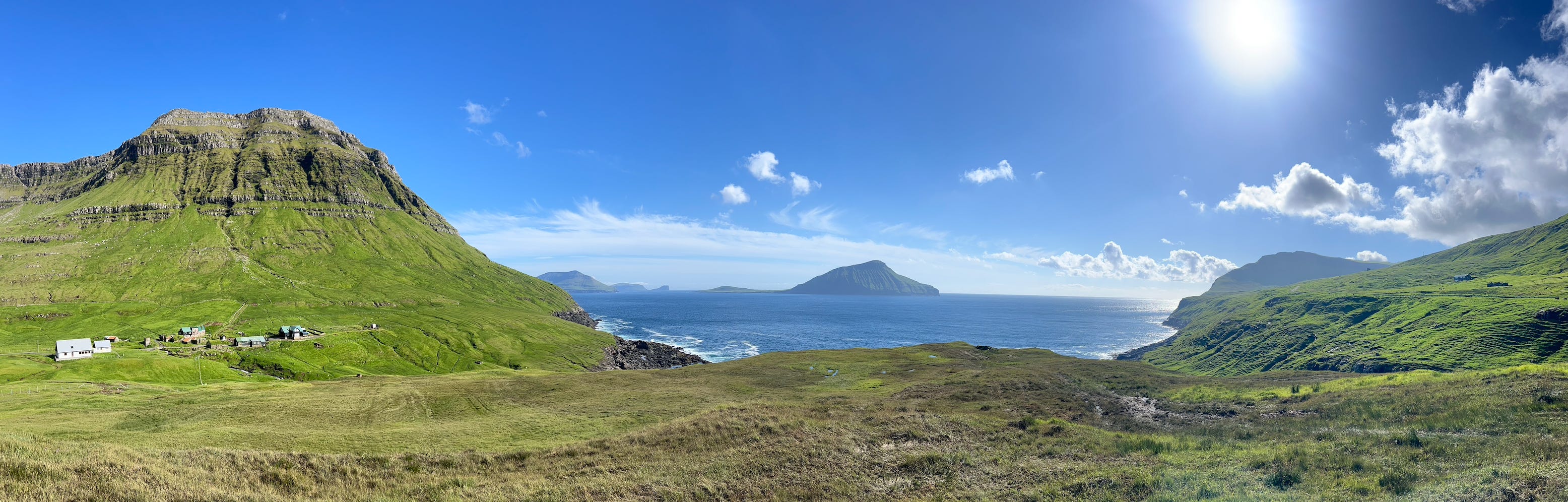
Norðradalur lies near the right angle of two coast arms, roughly divided by a creek running from the village into the sea. South from it rises the face of Middagssteinur, while the ridge of Dalsnípa bulges in the west.
With these two elevations framing the view, the island of Koltur emerges in their middle, a blunted thorn protruding from the sea.
The hose had left an imprint in the grass, and I followed it across the pasture. With the green, the smell of sheep dung faded, too.
I climbed down the cliffs, and whiffs of seaweed brooding in the sun took over. Limpet shells lay scattered along the rocks, whose texture I felt scraping against my soles.
In the area where the coastline flattened, the water from the creek fans out. Waves wash over stony plateaus that form the tidal zone, the swelling sea pushing back against the widening stream.
A small bird follows the foamy line where the creek and the sea meet, a young sandpiper, perhaps, running from the waves as if in play, taking to flight the moment the sea appears to win.
Water heaves where the skerries drop, and I hear the largest breakers displace the air with the sound of a car door slammed. I check the calendar. Low tide was two hours ago. The sea is rising again.
A high-pitched sound pulses through the rumble of the waves. Turning my head, my eyes lock onto a streak of orange, black, and white.
In the oystercatcher’s line of flight, I continue towards the arm of the shore that reaches westwards into the sea. Sun-dried seaweed crumbles under my hand as I seek hold on my way down.
Soon, my feet touches plants wet from the last high tide.
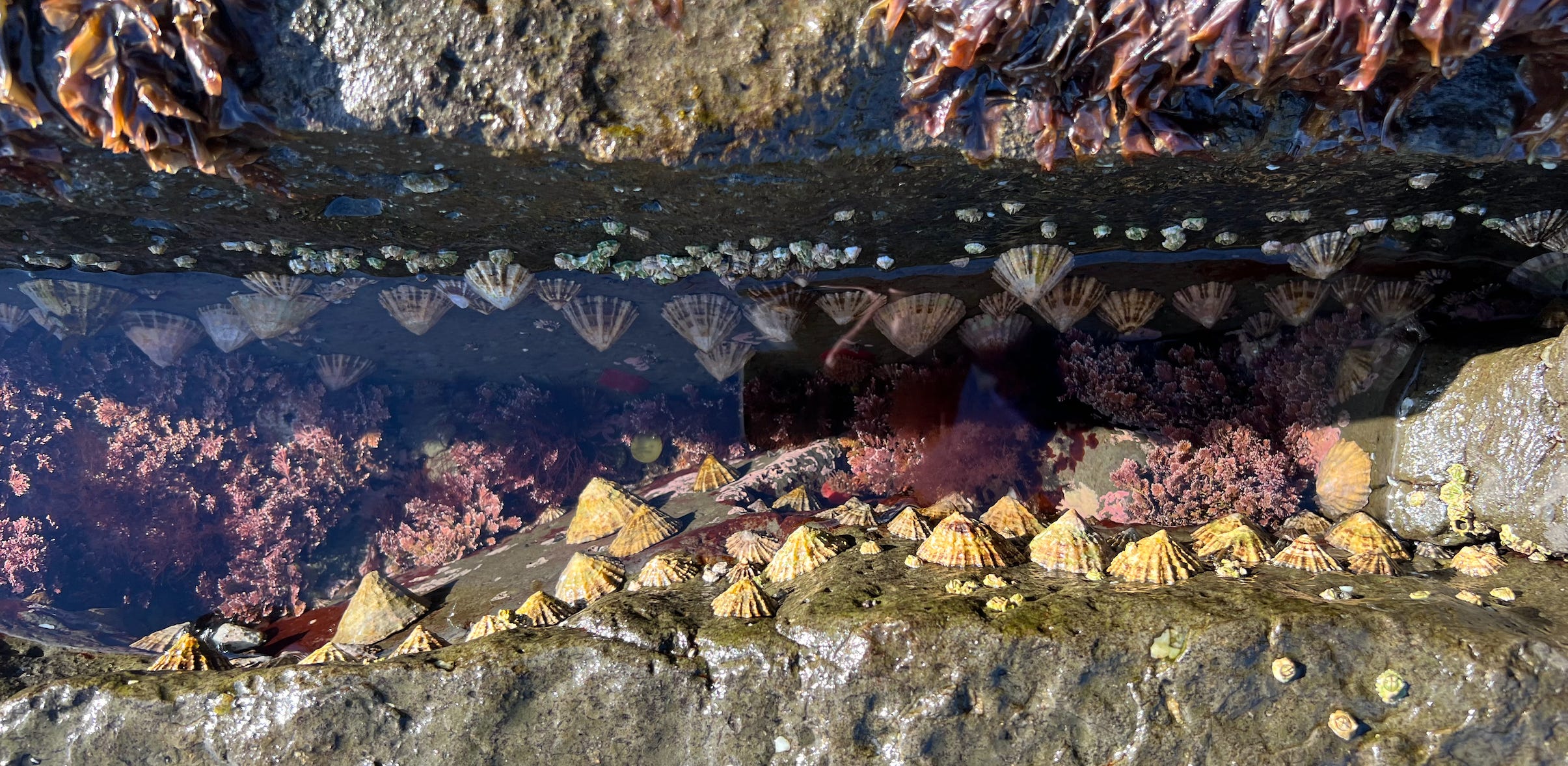
Clefts gape between the rocks, narrow pools filled from the swell and hit by the harsh light of the late afternoon. Algae of a rosy hue grow in the clefts and limpets cling to their walls like the teeth of a carnivorous abyss, their striated domes reminding of the islands that rise on this horizon.
The White Line
Across the skerries I move towards that place I hope to find closer to the waves – a spot from which a fine white line appears along the western edge of this shore: the fall of Nípufossur cascading into the sea.
It was this detail that I had chosen to approximate the position from which Gislander painted – a waterfall dropping down from the carved-out mountain bulge; perpendicular at first, then sprouting into the sea beneath.
In the seascape Gislander painted, the ridge around the fall lies brown from winter, and patches of snow still remain in folds of the terrain.
Gislander came here in early spring, the view suggests.
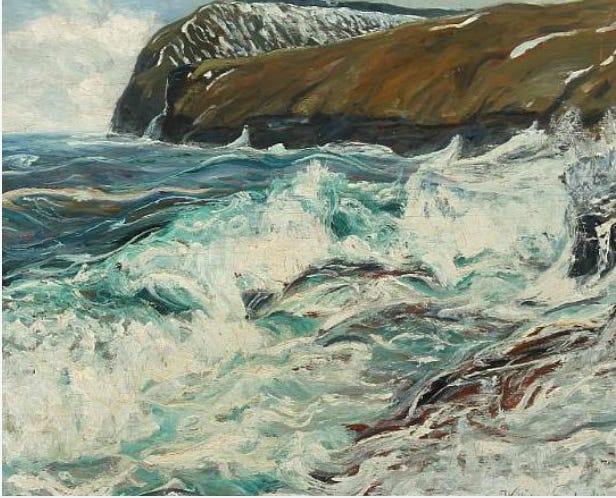
A little further down the shore, I find a spot where Nípufossur seems to align with the painting. Within a narrow margin of angles, I continue on slippery rocks as far as the incoming tide permits, exploring from where the shoreline best resembles the one Gislander painted.
In the carpet of seaweed, I seek pockets dotted with barnacles as I inch towards a prominent nose in the rocks, further towards the waves.
Each time the water hits, I suppress the instinct to evade onto soapy ground.
Back in 1924, Norðradalur was a village less accessible from Tórshavn. Had Gislander been put ashore here from a boat? I begin to wonder. He painted close to the splash zone, so much seemed sure.
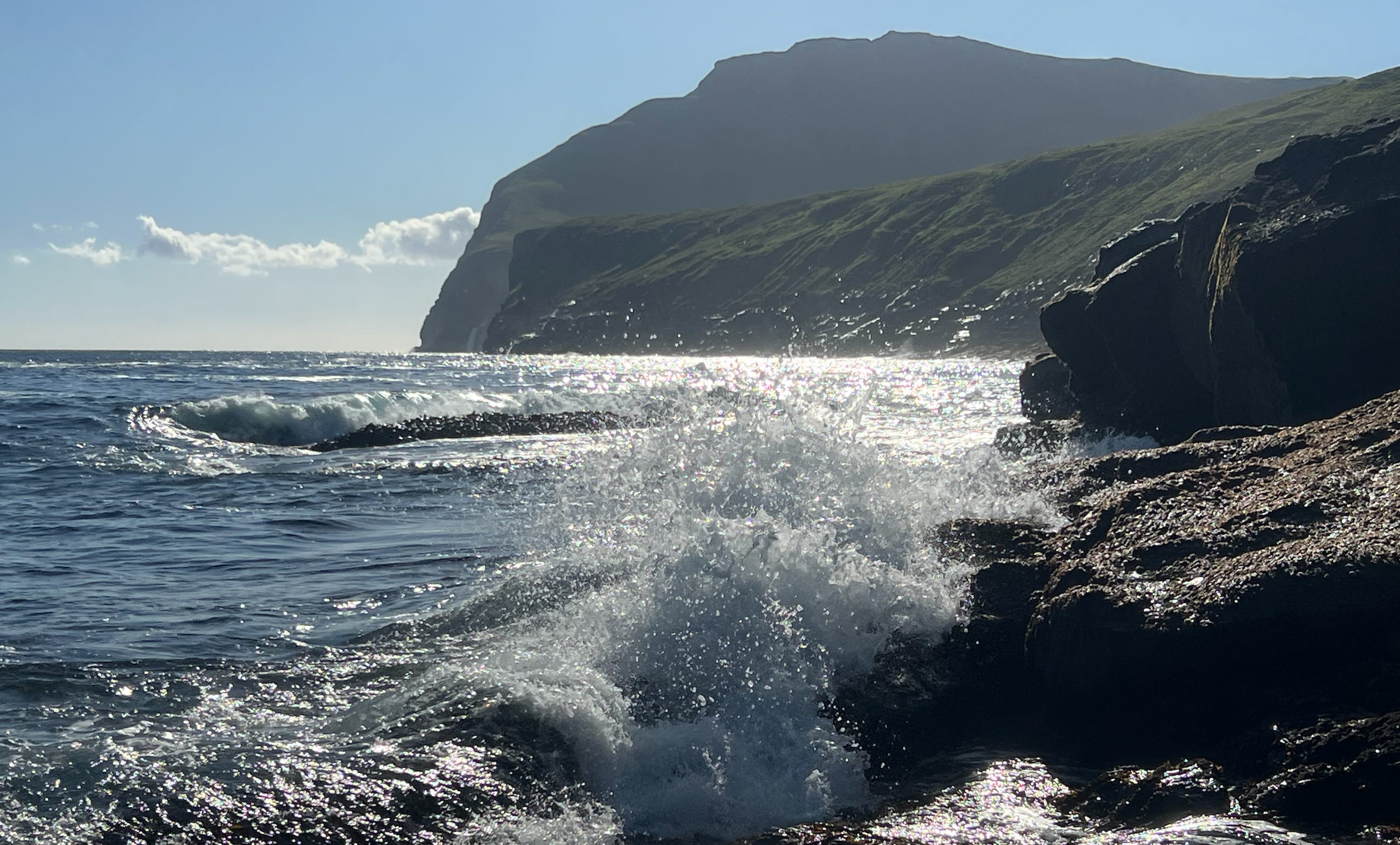
I moved a few steps back again, taking in the rhythm of the ocean at a safer distance. In the background, Nípufossur draws its white line against a backlit mountain ridge.
Up here, it dawns on me that the waterfall may not have been the only reason Gislander chose this spot. Some ten metres off the shore, the backwash of the surge rears the waters that push forward, rounding them into a barrel shining in translucent blue.
This is a perfect spot to study waves, I realise.
The Study of Waves
Wave after wave I watch form and collapse off the shore, and I note my mind wandering off to Uwe Johnson’s Jahrestage (‘Anniversaries’) and its opening lines, in which the author described the waves on the Baltic Sea:
“Crests stretched tight, already welted white, wrap round a cavity of air crushed by the clear mass like a secret made and then broken.” 1
Perhaps it was the certainty of waves that drew Gislander to this coast in the first place. From my vantage point, a reason for their shape becomes apparent.
Not far off lies a bank at whose edge first waves begin to form. Checking the original painting, I notice that Gislander had actually depicted this feature in th sea: a streak of brown shimmers to the left, beneath what seems to be high tide.
“The sea is clearly the right element of the artist,” I remembered an art critic writing in 1924, “but no longer the murmuring flirtation of the Baltic with the bathing beach, but foaming, thunderous breakers crashing against the rocky coast.”2
When Gislander exhibited his paintings in 1924, in the eyes of many critics his seascapes outshone his original subject. Against the water he elevated to the main protagonist, his birds became mere staffage.
The Faroes seem to have taught Gislander to paint the sea. Perhaps it was through these agitated seascapes that his presence stylistically mattered most for the young Sámal Joensen, who followed the Swedish painter around on Mykines in 1924.
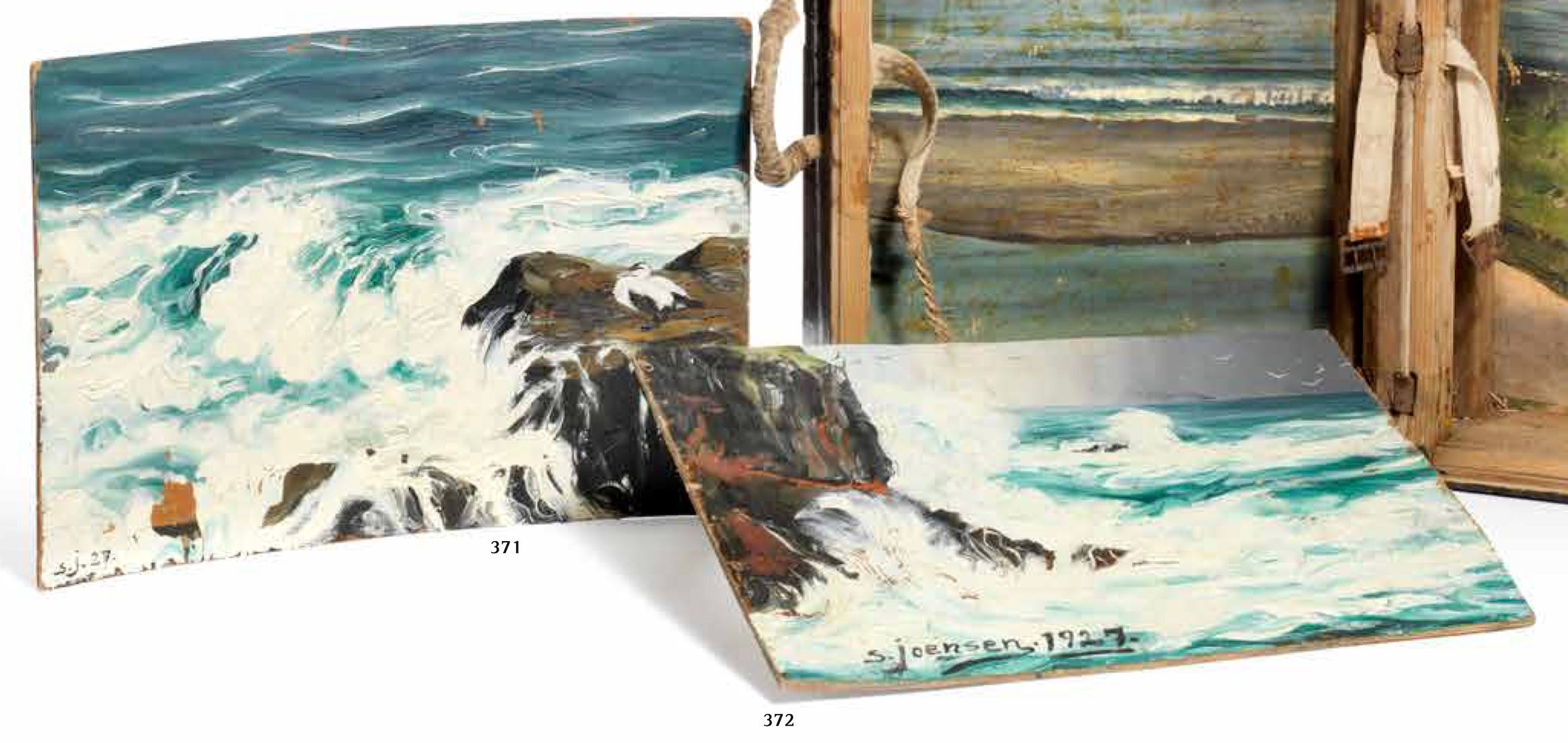
During the six weeks Gislander spent on that island, his own wave paintings reached a new intensity. His studies around the steep landing site on Mykines resulted in a series of paintings, depicting the towering formations of waves (e.g. see no. 1 and no. 16 in the Search List).
There are subtler tones in his paintings of waves, too – the forms in which he began to stylise the foam below their crests as they splash in sea caves, and whose fine moiré later reminded critics of painters such as Gustaf Fjæstad.
Overlooking the agitated sea, I thought that all this had in some way evolved from the early studies Gislander conducted along the Faroese coasts – at places like these, where the open Atlantic drives its waters against the coast of Streymoy, in a display of force and awe that was beyond anything the Baltic Sea could muster.
Over the past week, I had sought out viewpoints from which Gislander had painted, and it had left me untouched whenever I found our views coincide. Yet in sight of these Atlantic waves, there was a different sensation I felt arising.
Did Gislander experience the same awe, I wondered, when he stood here a century before, observing the waves as the Atlantic hurled its waters against these shores?
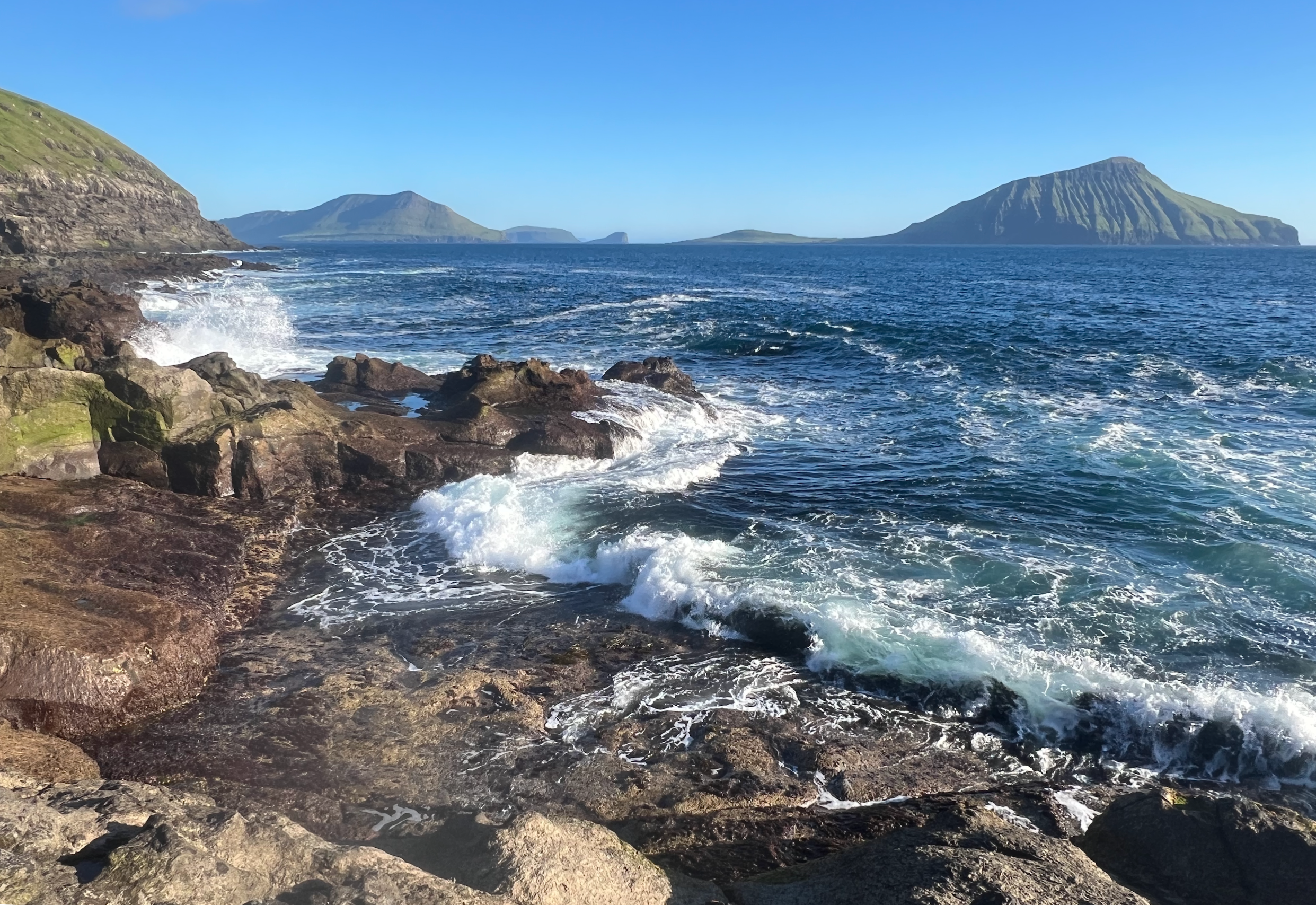
A further breaker hits the rocks, and the thought dissipates like the spray of seawater showering my back. A tongue of the tide follows racing up the rocks and breaks against my boots. The backwash is heavy, pulling my ankles towards the sea-grass, where one step means a slide down into the swell.
I choose to follow the barnacle trail back to higher ground.
A hood full of brine splashes down as I bow forward and begin my climb back to the pastures. Water squelches in my boots, wrapped in trousers heavy from the sea.
For a while, I had almost forgotten about the sheep.
Acknowledgments
I am grateful to Jens Dam Ziska for pointing me in the direction of Norðradalur to search for the spot where this painting was made.
This article was produced with the financial assistance of the European Union. The views expressed herein can in no way be taken to reflect the official opinion of the European Union.

I quote Damion Searls translation; cf. his discussion of the opening in his contribution on Words Without Borders (“Vitality Enough: Translating ‘Anniversaries: From a Year in the Life of Gesine Cresspahl’, published 6 September 2019).
Translated from Sydsvenska Dagbladet, 04.10.1924.