


To Nólsoy
“You need to talk to Jens-Kjeld.”
I heard the same sentence several times during my first week on the Faroe Islands. Whenever I mentioned details in the bird and wildlife paintings William Gislander made here in 1924, one name came up.
Jens-Kjeld Jensen has lived on the island of Nólsoy for fifty years. A self-taught biologist and naturalist, he has become one of the people through whom the natural history of the islands is seen and remembered.
From the signpost where the few roads of the village meet, I followed the arrow to “The Bird Man.”
Jens-Kjeld’s knowledge of the natural world has become part of how people here orient themselves. I had called him a few days earlier. “I heard you on the radio”, he said in a Danish cadence before I even had stated the nature of my call.
He was busy that weekend and couldn’t make it to the lecture, but he was happy to welcome me at his home the following week.
After a 20-min ferry ride out of Tórshavn, I followed the path uphill, out of the village of some 200 souls, to the yellow, second-to-last house above the shore.
The Likelihood of Swans
A man with white hair and beard in a striped shirt opened the door. He first came to the Faroes with the Danish Navy, Jens-Kjeld explained as we take a seat at his kitchen table. In his left ear, I noticed a golden ring.
I had selected the paintings depicting Faroese wildlife from the presentation I had given the day before. One of them, I had traced to the home of a Danish collector in early spring. In its background rises the hump of Nólsoy, on whose outer left I now was the guest of Jens-Kjeld.
“This may be one of the earliest,” I explained.
“Gislander came to the Faroes in mid-January 1924. He speaks of the wintry conditions into which he arrived. Because of the snow and the migrating swans, I thought this could be from February or March.”
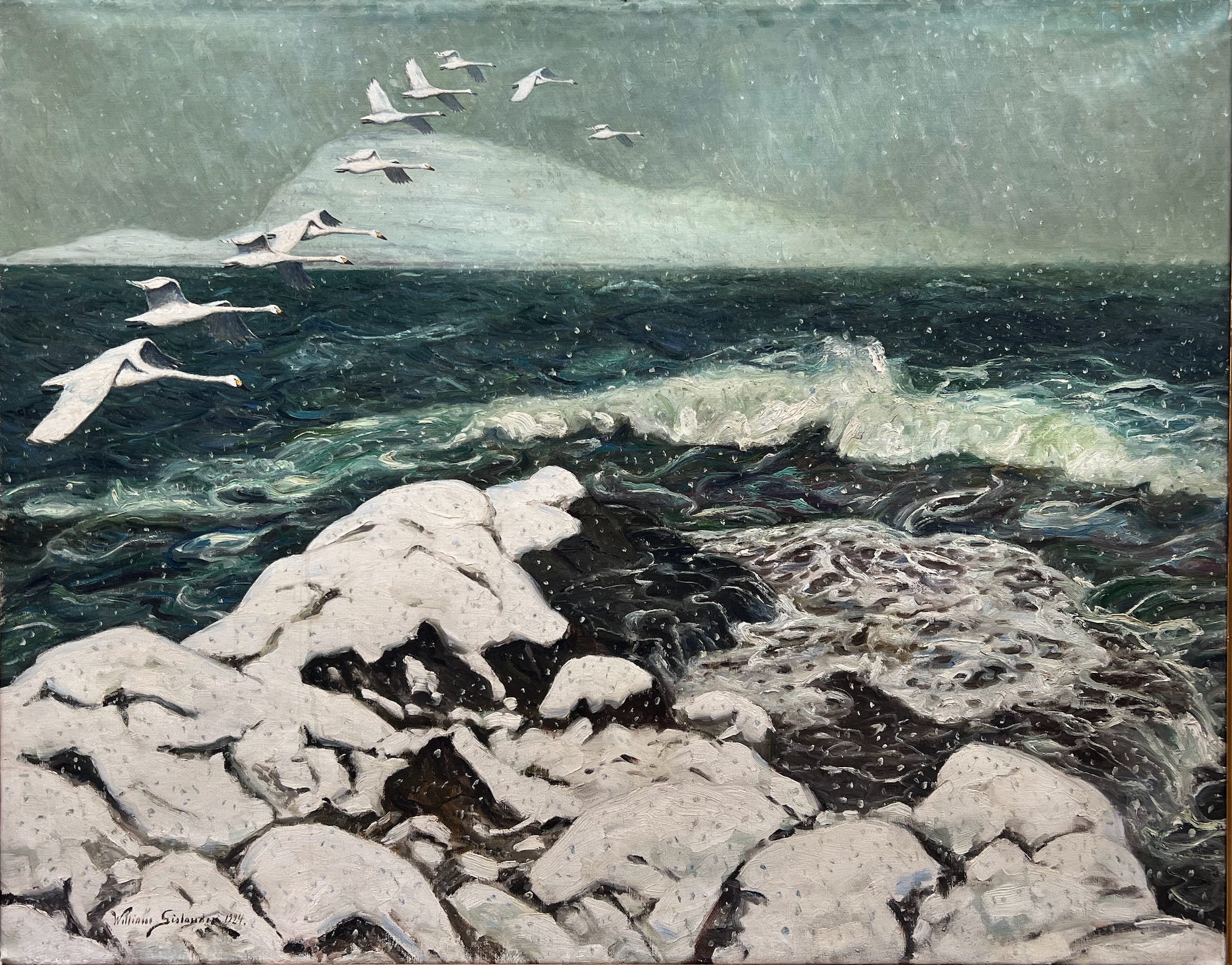
“Some years you see very few swans here on the islands,” Jens-Kjeld said. “It really depends on how the wind is that year.”
“What time of year do they usually show up?” I asked.
“I may have to go upstairs to check that on my computer sheet,” he said.
“If you don’t see them,” Jens-Kjeld explained at the table, “then the swans go straight over the sea, 200 km south of the Faroes. They only stop here if there is a low-pressure area between Iceland and the Faroes.”
“So it’s possible they stay for a few days in early spring – but only if the wind direction is bad that year.”
A few days later, Jens-Kjeld checked his spreadsheet, replying to my email: “Whooper swans have been seen in my notes on their way to Iceland throughout the month of March and a few days into April. And back to Ireland and Scotland in October. But there can always be some exceptions.”
The ifs in his explanation had planted a seed of suspicion.
I had seen photographs of other works by Gislander with swans over land- and seascapes – works he had painted elsewhere, in different years. From his formative years in southern Sweden, Gislander knew his swans – that much seemed certain.
There was also a similar painting by Gislander from the Faroes I had found reproduced in a 1924 newspaper. Again, it showed the hump of Nólsoy in the background, the swans flying in the other direction (a study for the first one)?
I began to wonder about records of weather conditions south of the Faroes in 1924.
Do they reach back far enough to tell us something about the likelihood of swans?
Winter Shades
I flipped to the next slide.
The snow-covered promontory of Eystnes appeared, as seen somewhere from the coast of Tórshavn. In the middle, a flight of Eider ducks passed a sea whose translucent waves revealed shades of the ground.
“I wondered if this could be from around the same time, because of the snow”, I said.
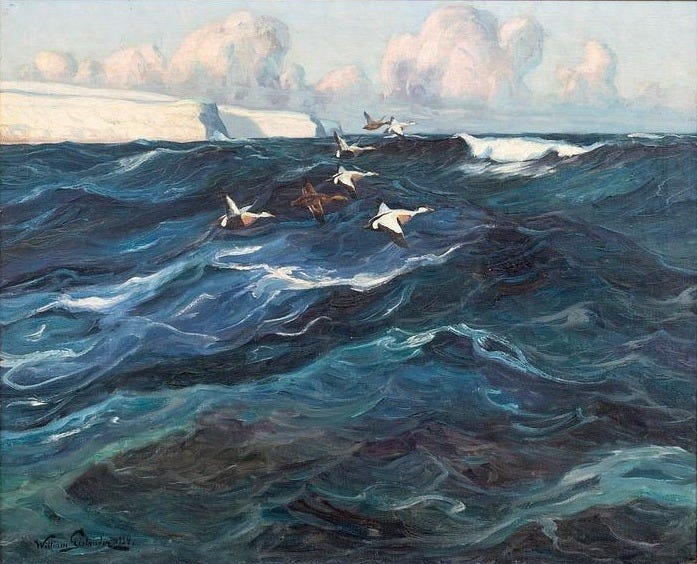
“The Eider is not like the swan, it stays here the whole year,” Jens-Kjeld explained. “The male’s plumage is completely black in summer. Here it is still in winter plumage.”
“So this could well be March, April, perhaps May, but not later.”
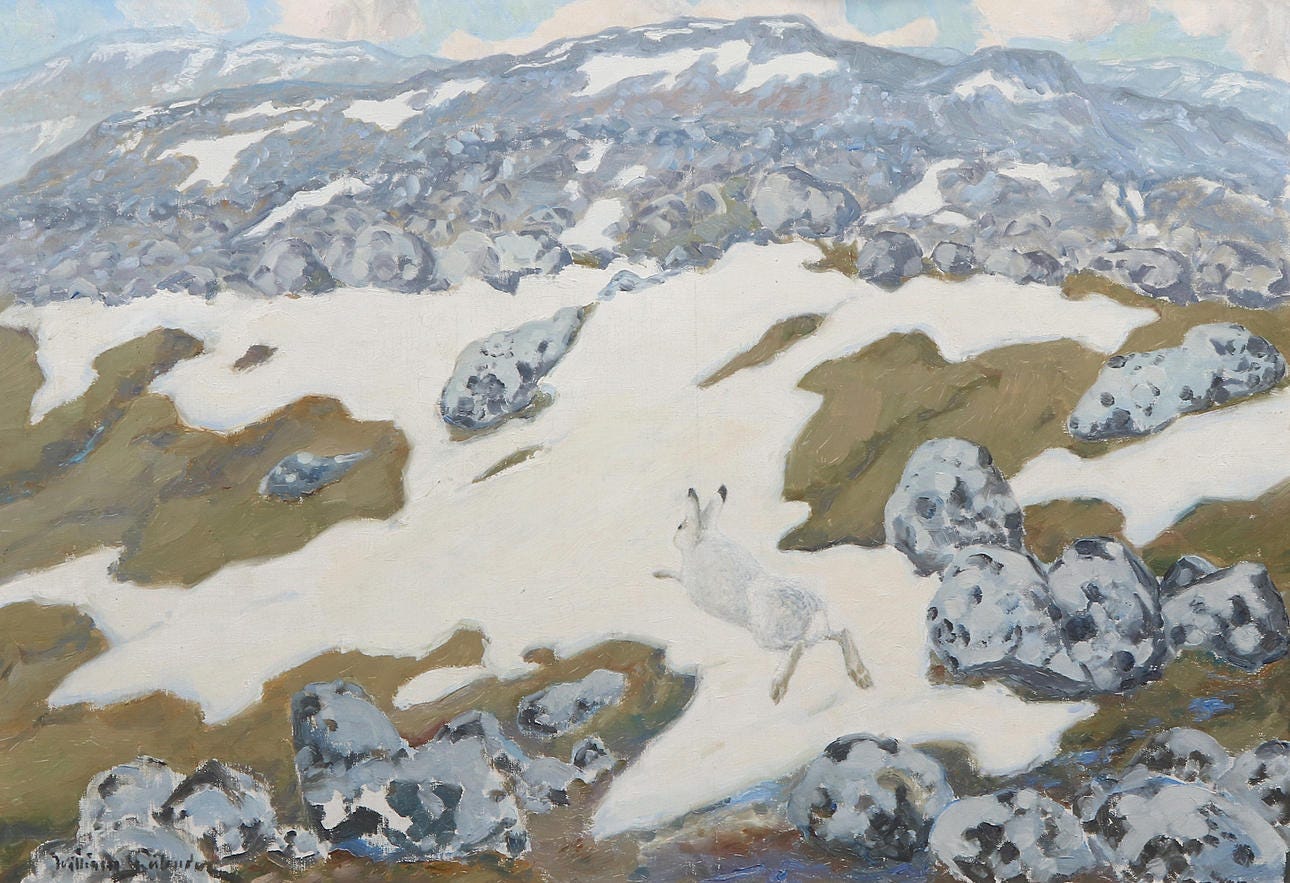
“If we follow the seasons, then we come to this painting here,” I said, flipping to the next slide. “In this one, the snow has already retreated.”
“Here you can see a hare leaping towards the mountain slope,”
“There is a hare?” Jens-Kjeld asked.
I pointed to the elongated form leaping over the snow patch, its fur and the black tips of its ears recalling the boulders dotting the surrounding slope.
His eyesight has diminished, Jens-Kjeld explained as he reached for a magnifying glass. I zoomed in as far as the resolution allows.
“This is very interesting,” he said.
“The hare is completely white. Go around the corner and have a look at the colour!”
I followed his directions into the adjacent room. Above a work bench hung a scientific drawing of a mite named in his honour. Three rows of shelves ran around the corners. On the top shelf, half a dozen of puffins faced me.
Moles and other small animals hung from wires, their teeth exposed. The furry curtain veiled the middle shelf, where Jens-Kjeld kept the chemicals and instruments he uses to stuff animals.
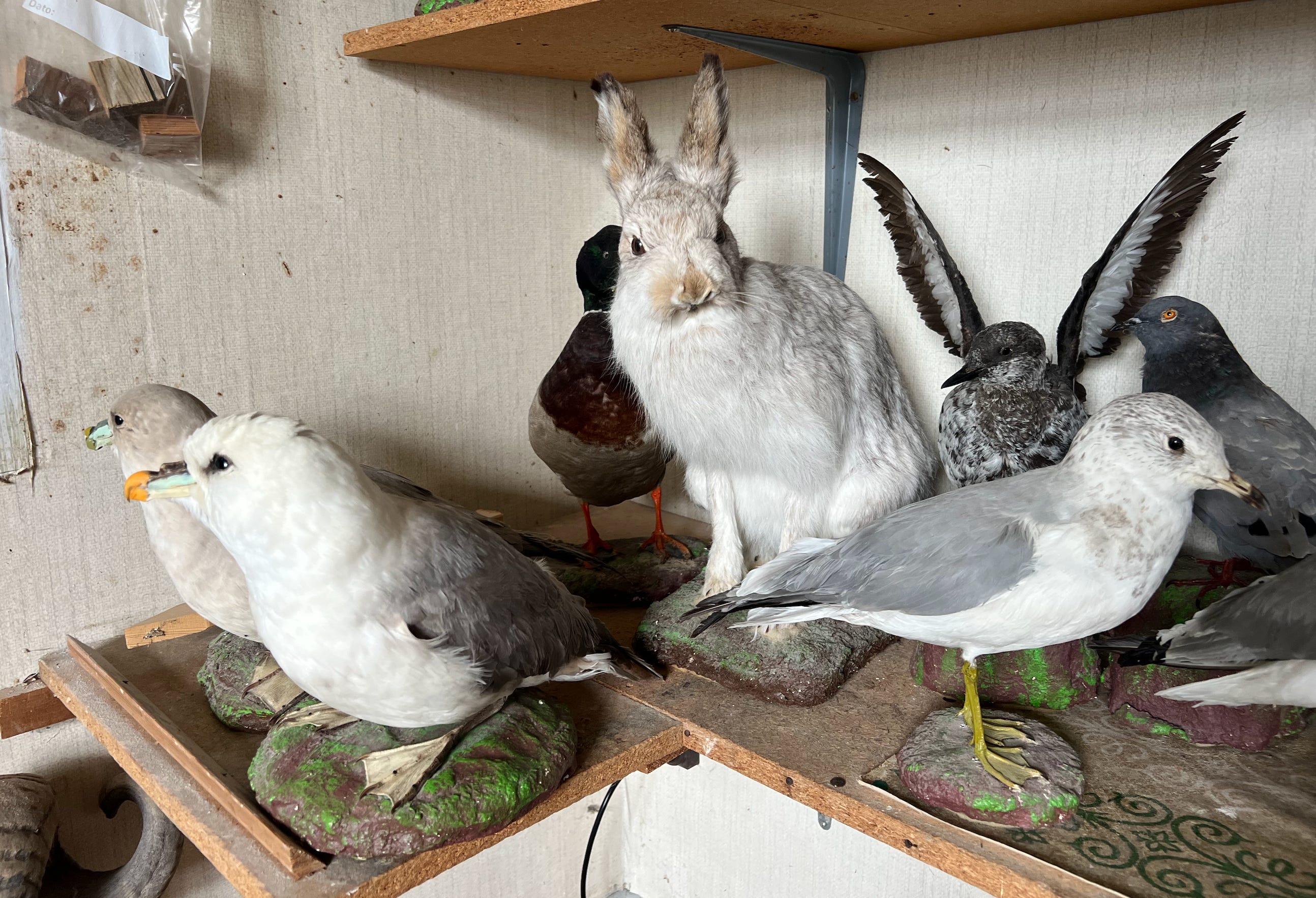
Further down, in the corner of the lowest shelf, I spotted the hare.
“You can see this is not white – this is blue,” Jens-Kjeld said. “In 1924, I think all hares in the Faroes were blue.”
“Blue?,” I asked somewhat perplexed.
“Well, you can see this is not completely white,” he explained.
“This species – it comes from Oslo, or from the south of Norway. It came to Faroes in 1855. After another fifty years, if I remember correctly, there were no white hares left in the Faroes – only the ones with the blue-grey fur. There is little snow here, so the white ones are easier to shoot.”
“You need to talk to Eyðfinn about this,” Jens-Kjeld added. “He is the expert for hares. If this picture is from 1924, I think there were no more white hares left. So maybe Gislander painted a very, very rare one.”
“But I mean there are some blue-grey spots here, if you look at the rear part,” I objected back at the screen. “You still think this is supposed to be a white one – perhaps the last one?”
Jens-Kjeld smiled. He maintained the hypothesis for the time being, and we agreed to let Eyðfinn have the final call.
“That would have been a real coup in 1924,” Jens-Kjeld said.
Eider Ducks, Summer
The last slide brought us to a living room in the suburbs of Copenhagen. Before Christmas, I had seen a painting of Eider ducks in a private collection.
I increased the zoom, and Jens-Kjeld closed in on the screen with his magnifying glass.
“Very interesting …” he said, and left for the other room.
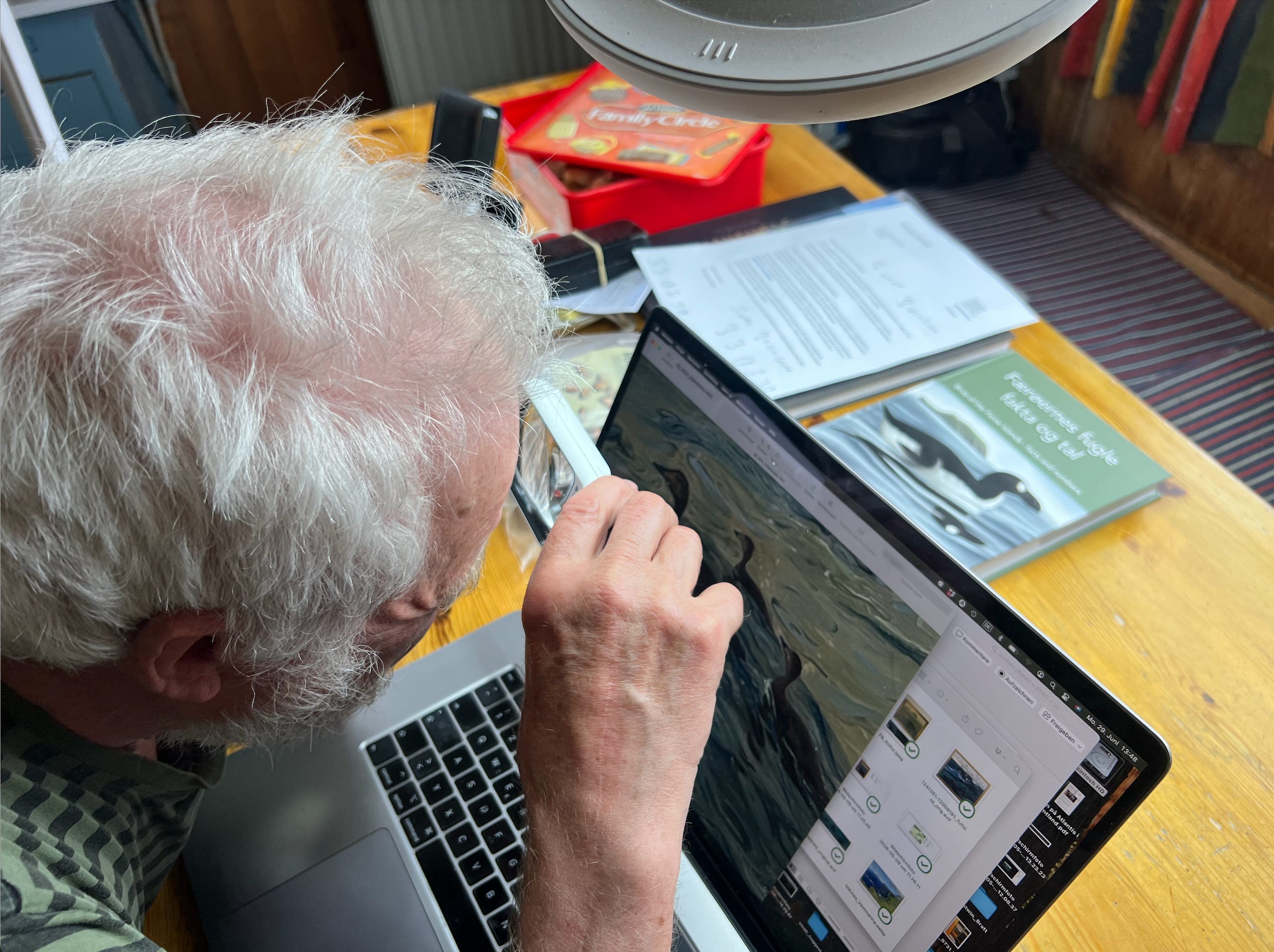
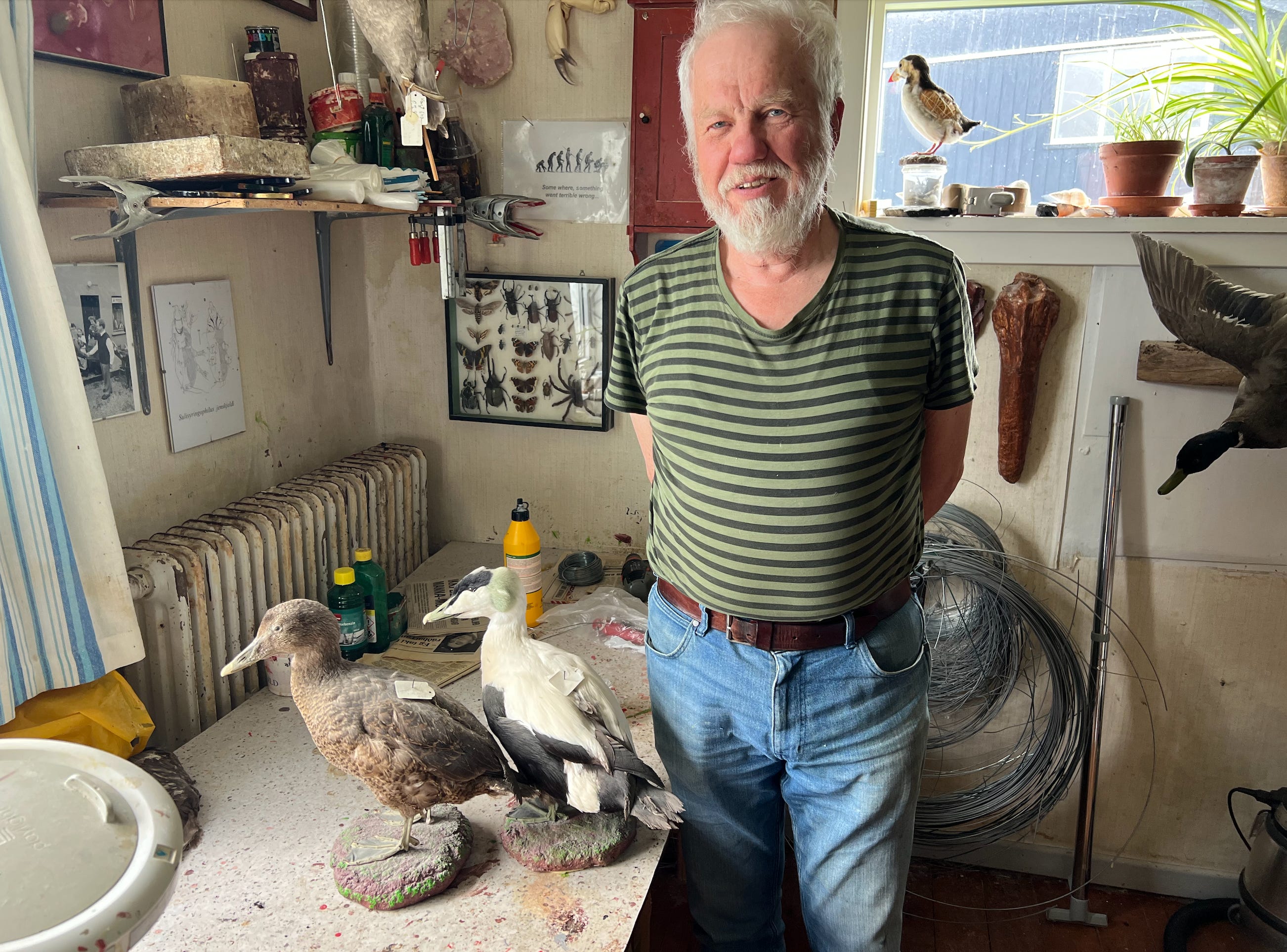
He returned with a female Eider duck he had stuffed.
“If you look at the head in that painting, it goes straight up this way,” he said, pointing with his finger at the duck’s beak.
“Here you can see” - he pointed at a noticeable bump in the beak of the stuffed specimen – “the head goes ‘upstairs’. In Eider ducks from Sweden or Norway, it is flat.”
“You’re sure this is from the islands?”
I zoomed out again, revealing the ridge of Koltur on the horizon. The case seemed clear.
“So this suggests he painted the ducks as he knew them …”, I speculated. “He painted them as he had learned to paint them in Sweden.”
“Yes, that’s perhaps more likely than a Swedish Eider in the Faroes …”
Reading Change
Over the slides that remain, I collected notes from Jens-Kjeld’s observations. Many of them opened up a historical dimension in the paintings. I began to see birds in them that have disappeared (such as the cormorant), or whose migration patterns have changed.
“You’ve lived here such a long time,” I asked – “I suppose you’ve seen a lot of change over that time?”
“There is a lot of change across the islands, all the time.”
“If you take butterflies – 70 years ago, there were 55 different ones known. Today, there are 170. Some of them did not breed here for 100 years. Now they are all over the place.”
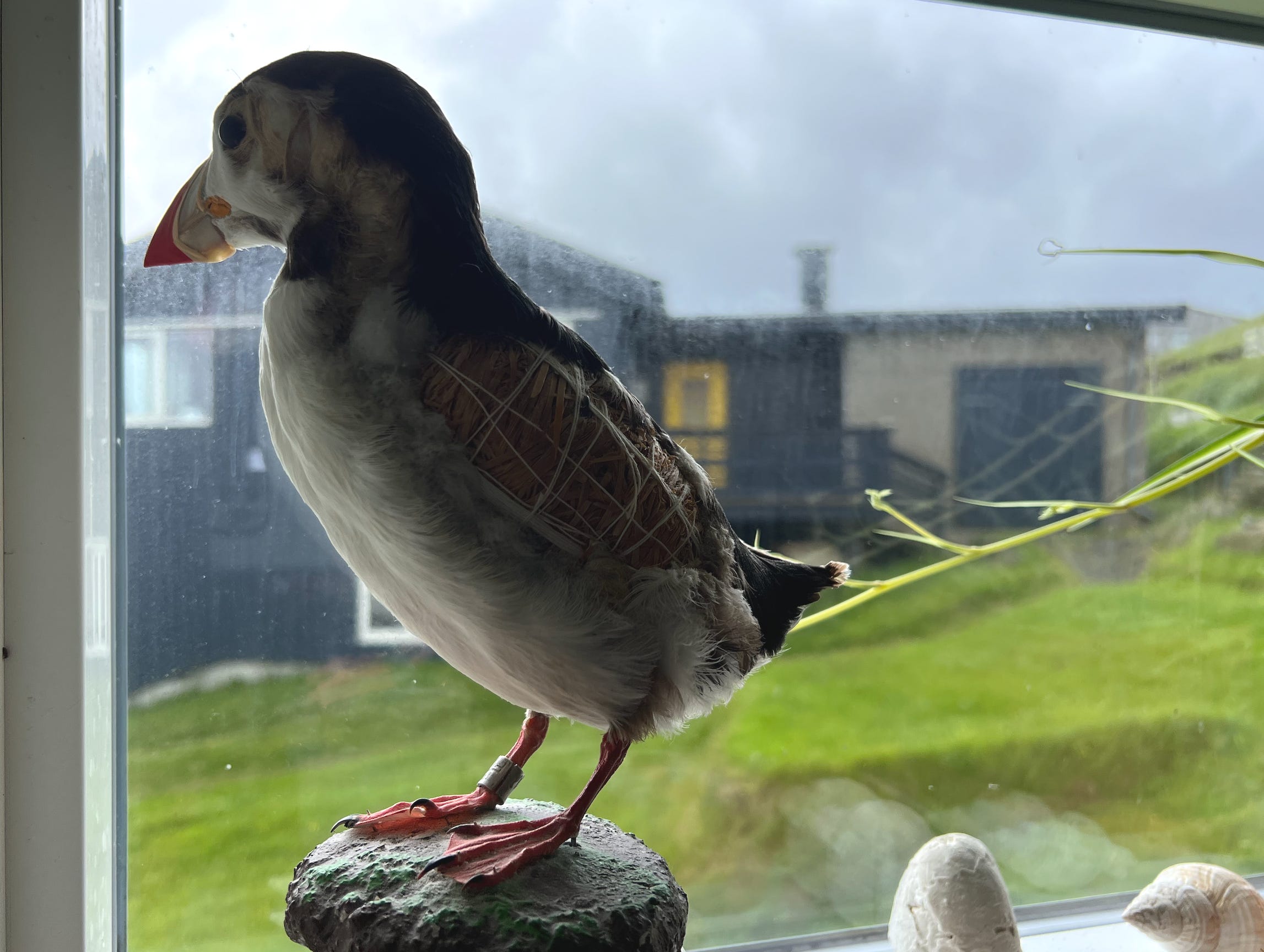
“With birds – 25 years ago, the robin didn’t breed here. The blackbirds have also returned. Then, the cormorant has disappeared. Other birds have become rare. The puffins have been fluctuating a lot. Today there is about 5% of their original population left.”
“But with the insects – are there more species now?,” I wondered?
“No, I don’t think so,” Jens-Kjeld said. “I think the population goes down. The reason you have more species now is because people have more time looking.”
“You know, I studied hoverflies,” Jens-Kjeld continued. “There were 12 – now it’s 29. Same with lice, fleas, or with mites on birds. It’s only because weird people do research on that.”
Over decades, articles that Jens-Kjeld wrote connected him with fellow enthusiasts on the islands and beyond. So did his appearances on the radio. Today, many researchers come to Nólsoy – to study the colony of storm petrels in its east, or the plants and insects thriving on the island.
“People seem to be more interested here in what surrounds them,” I said, “at least the ones I meet. They help me to see things I can’t notice. I really appreciate that.”
“It’s the same with many of the things I do,” Jens-Kjeld concurred. “If you talk to local people on a small island – some of them know a lot of very strange things you never think of knowing about.”
“A few years ago,” he added, “we were in a small village on Kalsoy, in the north. I talked with an old man, in his late seventies, about a special flower. He had last seen it when he was young.”
“He said: ‘If you go “upstairs” there, and go a little to the left, there are the flowers there. I have not seen them for the last 55 years. But I remember I have seen them there.’ And we go upstairs and, we found a very, very rare plant in Faroes, a bell flower – 20 plants in one small spot.”
“Many times, it went the same. There is a lot that people on the islands know. It’s incredible.”
I couldn’t agree more.
Epilogue
Less than 24 hours after our encounter, I received an email from Eyðfinn. Subject line: “Færøenes hvide hare ??” (“The white hare of the Faroes ??”).
He works a lot with Jens-Kjeld, Eyðfinn wrote. He had mentioned the 1924 painting to him right away.
The last ‘winter white’ hare was documented to have been shot in the winter 1916/17, he wrote, approximately 60 years after they were translocated to the Faroe Islands.1 Whether I could send him the painting I had shown to Jens-Kjeld, he asked.
An hour later, my phone rang.
“No no,” Eyðfinn said. “It’s already Norwegian one.”
No big coup today. But a reminder of the unexpected questions these paintings can still raise.
References
See Danmarks natur, vol. 12: Færøerne, ed. Arne Nørrevang, Copenhagen 1982, p. 117: ”... og den sidste hvide hare, vi har helt sikker vidnesbyrdet om, blev skudt vinteren 1916-17.”
I am grateful to Eyðfinnur Magnussen for the reference.
This work was produced with the financial assistance of the European Union. The views expressed herein can in no way be taken to reflect the official opinion of the European Union.
