


Water trickles on the quay in Fuglafjørður – J.S. Bach is hosing down his station wagon.
The name leaps out from a red track suit. With his back to me, Bach pulls the hose around the car. In the wet windshield, the mountain surrounding the bay appear in reflection.
That morning, I had woken on the opposite side, in Kambsdalur. Above the village rises the cone-shaped Mount Kambur, part of the mountain chain surrounding the bay – and the subject of the view I had come to trace.
A tip after my lecture at Listasavn had brought me here, to the eastern side of Eysturoy.
“I think I know where that picture was made,” Martin had said after I showed him the auction photograph. Seeing me struggle with the Faroese spelling, he wrote down his suggestion: Fuglafjørður / towards Kambsdalur.
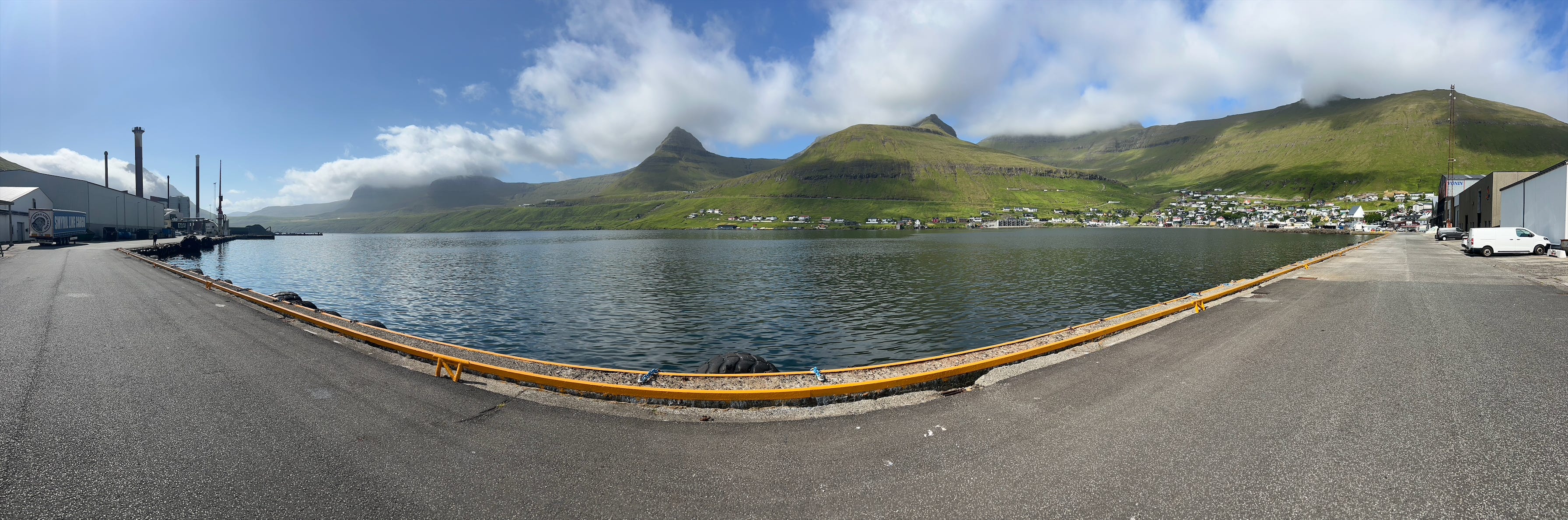
The sun had just begun to lift the shadow Mount Borgin casts over the industrial harbour. On the way to the water, I pass a sign in a red frame: “Welcome to Port of Fuglafjørd.”
The town’s name means ‘fjord of birds’. Beneath the words I spot a coat of arms – a red bird above three fish. Long before I reach the waterside, the smell reveals that the town is a hub of local fishing industry.
The Grey Line
The quay lies empty of ships this morning, and two yellow rails run along its edge. I follow their parallels down the harbour wall, my gaze fixed on the mountains across the fjord.
Almost exactly 102 years earlier, the steamer Sleipner had called at this bay. On 22 July 1924, William Gislander was on board.
From behind me, I hear the creaking of a metal hinge. The hollow echo of steel container walls follows. Cold-storage facilities have been excavated into Mount Borgin, and another workday is already in full swing.
Gulls wheel high above the chimneys, sending distant calls from the sky. A fulmar writes silent figures of eight as it patrols over the harbour basin, the drag from its wingtips drawing a wake at the turning points.
In the painting Gislander made of Kambur on the opposite shore of the bay, waterfalls draw white veins across the green slopes enclosing Kambsdalur. One of them emerges from the valley between the mountains. When Gislander set up his easel, ‘Kambsdalur’ then referred primarily to this valley; the village of the same name would not be established for another half-century.
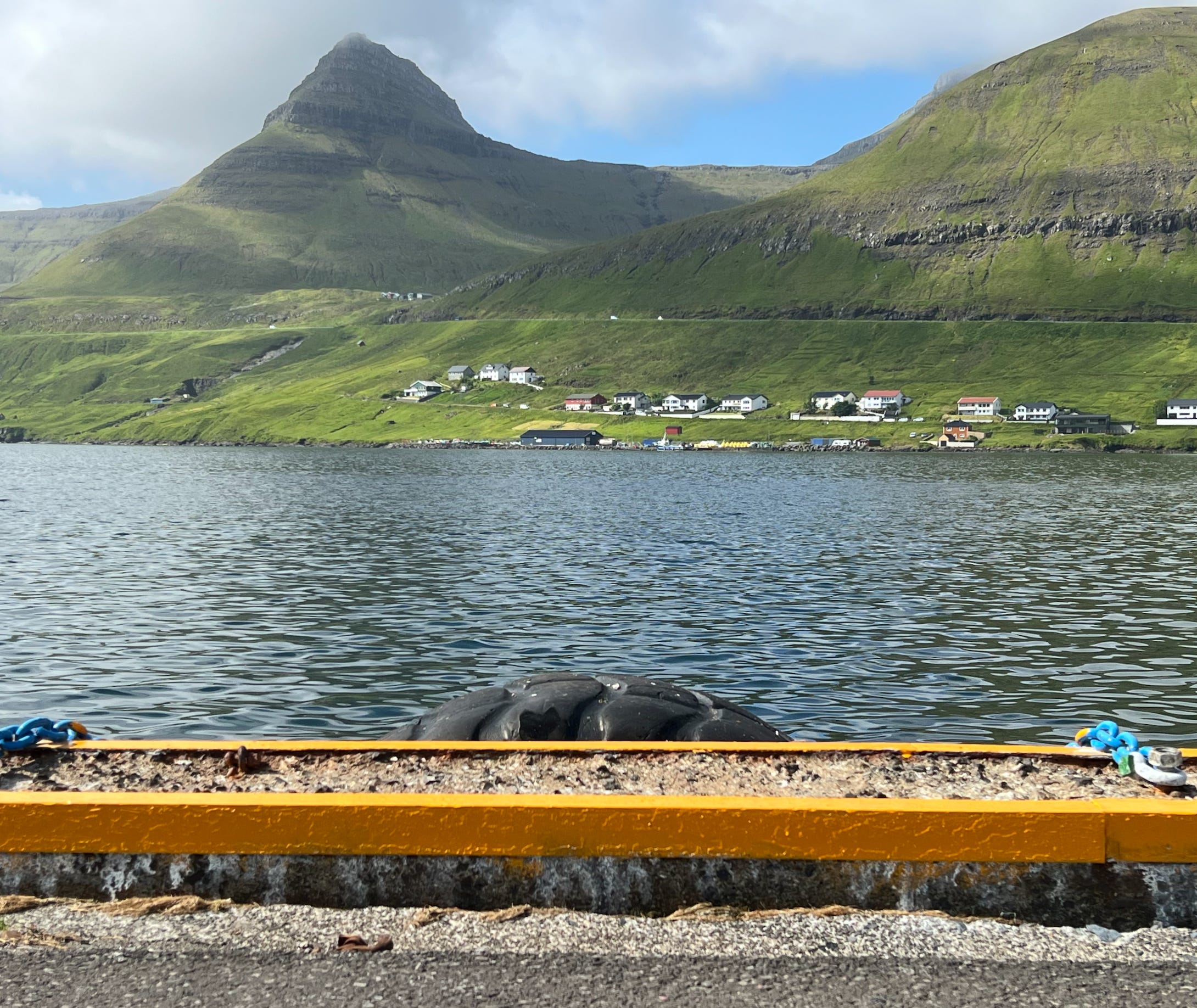
Closer to the sea, a grey line crosses the waterfalls in the painting, gently descending as it hugs the lower slopes with almost mathematical precision. Across the bay, I see the same line carrying trucks and buses down to Fuglafjørður as if on a marble run.
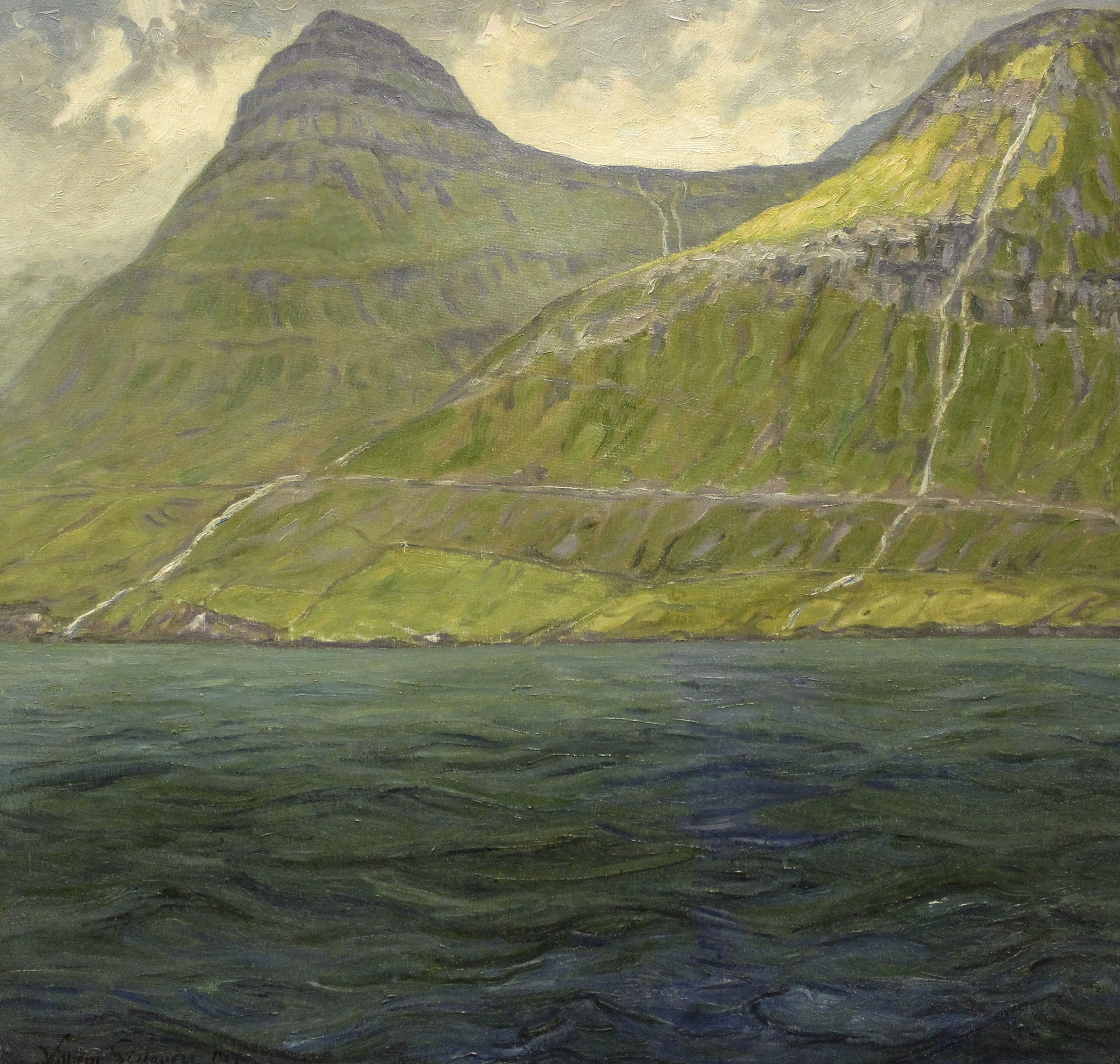
I see rags of cloud move across Kambur. The watercourses Gislander painted a century ago have cut deep into the green below, and shadows cast by the hard sunlight are filling the scars.
The ridges continue to align just as in the painting as I continue a little further down the quay. The angles seem almost exact.
There is little doubt this is the spot. I raise the camera, then hesitate.
The Faroe Islands that Gislander’s exhibition presented to audiences in Copenhagen appeared untouched, void of human infrastructure.
To make my photograph resemble his painting, I would have to repeat this choice – and leave the harbour outside the frame. Yet already a century ago, a regular steamer service had given the painter access to the north-east of the Faroe Islands. Perhaps Gislander had even made this painting from the deck of the Sleipner, engines running.
A hundred and two years later, I decide to take a step back before taking the picture.
At the End of the Quay
I follow the yellow rails back to the head of the quay.
At their end, the man in the red tracksuit is still washing his car. Eventually, I give in to the urge.
“Is there is a local sportsman with the name of Bach?” I ask.
“No,” he says. “That’s the name of a composer.”
Then, after a moment, as if reacting to my puzzled face: “You can order them printed like this.”
It turns out that I am talking to the organist at the local church. He tells me that he plays Bach at almost every service, mostly cantatas. We drift into a Bach digression: Busoni’s transcriptions, Víkingur Ólafsson’s performances of them, the organs of Marcussen and Silbermann.
“Heðin,” he says, “Heðin Kambsdal.” He points across the bay. “It’s the name of the valley over there, beneath Mount Kambur.”
When I searched the church schedules later that day, I discovered that he was a painter, too. Again and again, Kambur appeared among the works he had exhibited across the islands.
I had spent the morning searching for the view point from which one artist had painted Kambur a century ago.
Another had been behind me all along, hosing down his car.
This article was produced with the financial assistance of the European Union. The views expressed herein can in no way be taken to reflect the official opinion of the European Union.
