

To the White Brushstroke
Following William Gislander to the Mykines Lighthouse.

The Window
The mist is descending again over the ridges.
From the church building of Mykines, I look towards where the island’s summit ought to be. For the past few days, I have not seen the highest peak once.
Mons Pileatus, I recall the page in Ruskin’s Modern Painters – the cloud-capped mountain.1
In the other direction of the peak, the winds from the west hurl waves into the narrow landing site. Through the silvery haze, I glimpse white crests out on the sea.
The island’s graveyard separates the church from the school, both painted in white. I find the door open, and on one of the wooden benches I take a seat.
A dry-stone wall keeps out the winds I can see brushing over the turf roofs outside. On my skin, I feel the naked stones radiate cold.
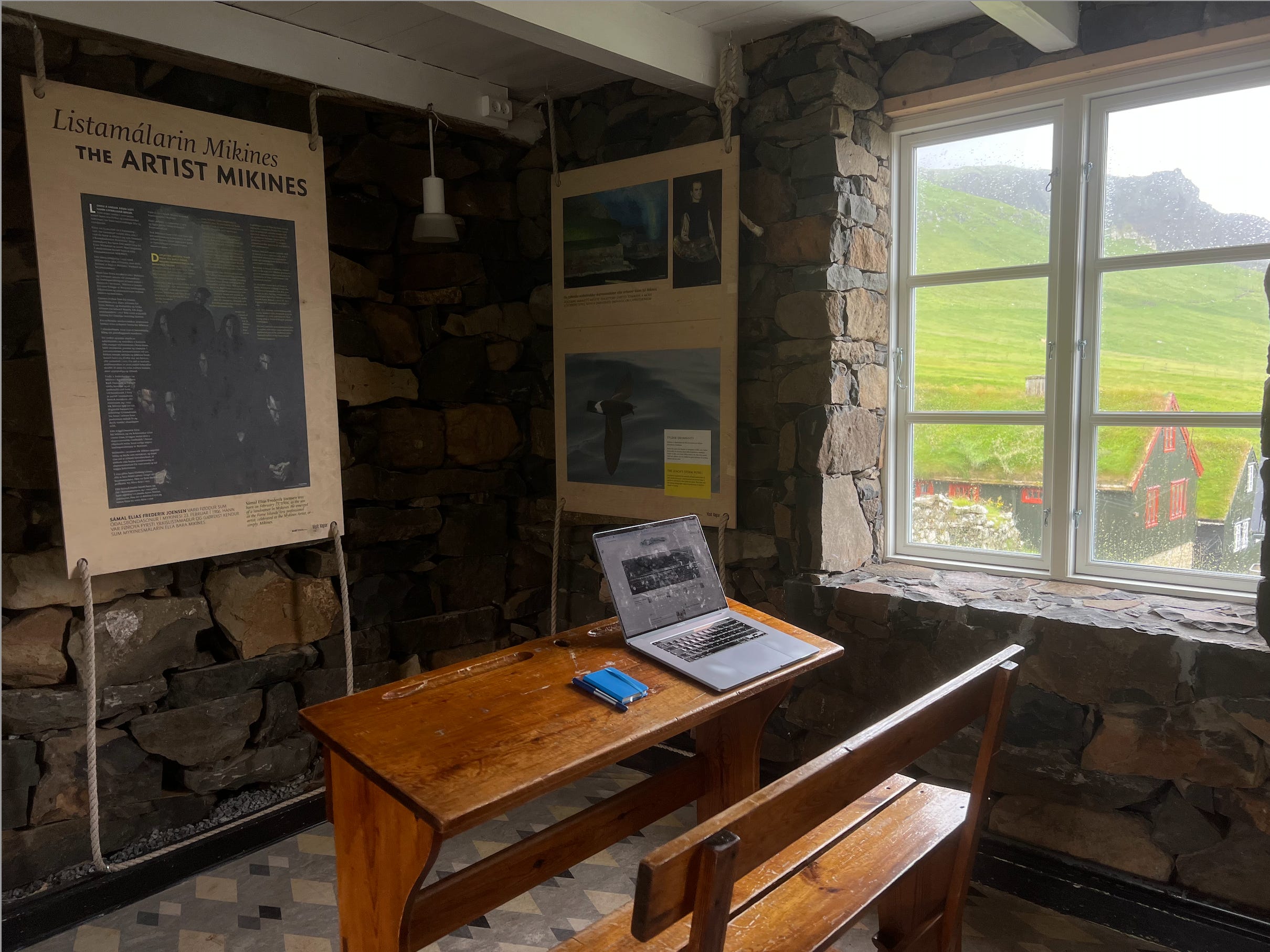
Through the window, my view wanders towards the ridge that rises south of the village. The silhouette of a person in rain gear emerges and disappears again in the mist: a farmer is working on a sheep fence.
Somewhere up there I know the vantage point to lie from where Gislander made one of his twenty landscape paintings from Mykines. The work shows the Hólmur – the finger of land with which the island reaches west.
Yet today is not the day to connect with the view a century later:
Mist is cutting the Hólmur short.
Time Passes
Four panels cover the school’s head wall. They inform visitors on the archaeology, birds, and art of of Mykines.
Two of them are titled Listamálarin Mikines – The Artist Mikines.
The painter’s first exhibition in 1927 is mentioned by the panels. The summer of 1924, when the eighteen-year-old Sámal Joesen Mikines encountered William Gislander and was amazed by his large-format landscape paintings, is not.
A few weeks earlier, I went to see one of those paintings at Gallerí Havnará in Tórshavn. The painting is currently for sale, and through the glass front, I see it lean against a fair-faced concrete wall, still enclosed in plastic and tape.
I had first met Bógi and his wife # – the owners of the gallery – at a vernissage a few weeks before. When I return that evening, Bogi has already brought the painting out of storage.
I call him and watch the nearby river, which gives the gallery its name, play with a ball caught in a waterfall.
A few minutes later, Bogi arrives in work clothes. He is renovating upstairs, he tells me, as we unwrap the painting. Together, we lift the frame to the wall, then take a few steps back.
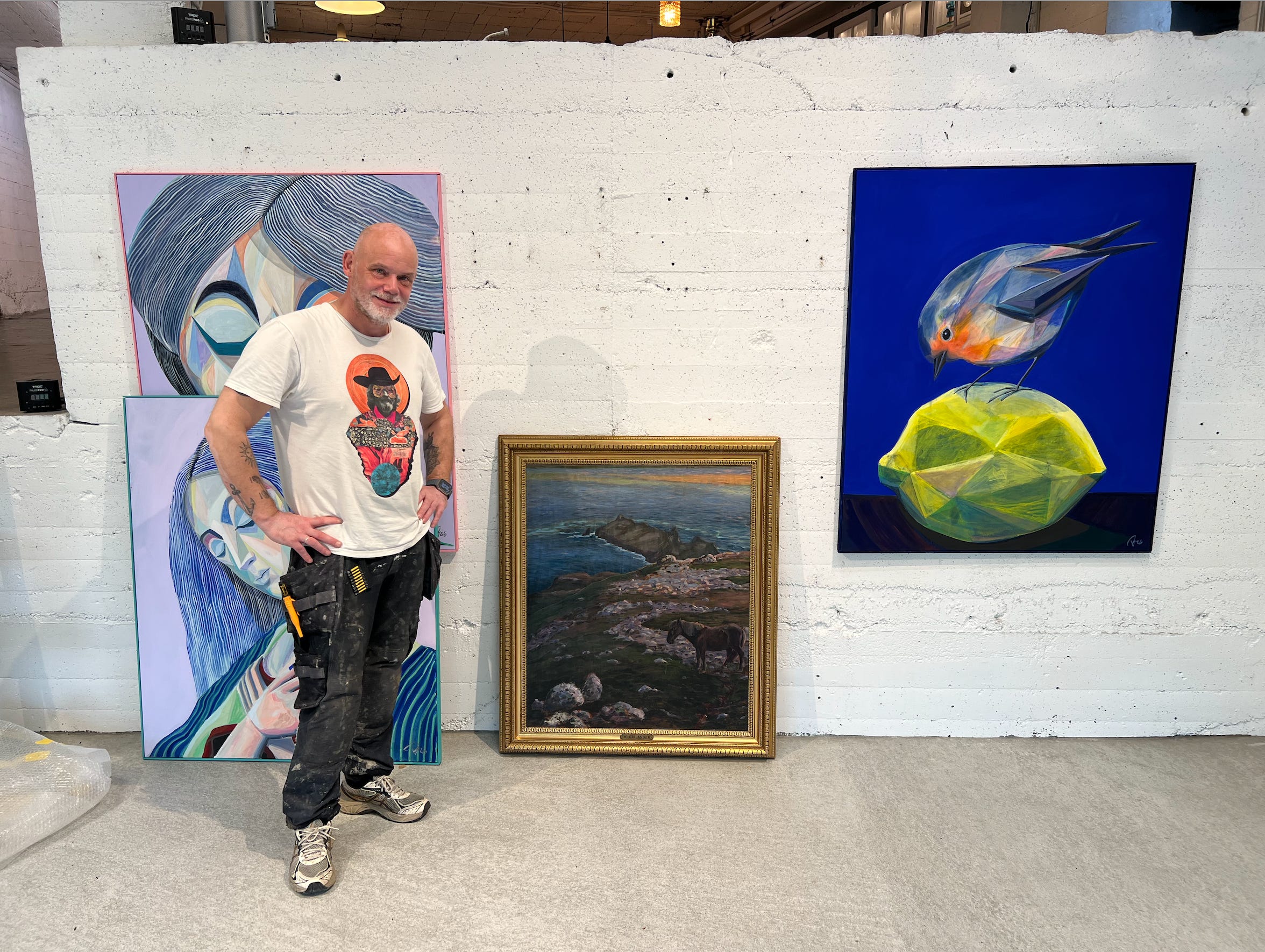
What strikes me first is the darkness.
I had seen a photograph of the painting on the gallery homepage. It shows the motif in bright colours, some parts overexposed. “It is really hard to photograph well in this light,” Bogi explains as I adjust my camera.
The painting had been stored for decades in the attic of a previous owner, he adds, probably forgotten among some other hundred she collected. The tape around its wrapping fell to pieces when they removed it, Bogi says.
“I guess to some degree, the darkening comes from the varnish,” I say. Up close, I see streaks running vertically across its surface, presumably from the protective cover applied a century ago. The frame and brass badge at the bottom still seems the originals applied for the 1924 exhibition, similar to the ones I had seen in other paintings.
In this one, lichen-covered boulders mark the foreground, capturing the light of the late evening. Beyond the edge of the ridge lies the village of Mykines, the white walls of the church and the school, and the black houses with their grass-covered roofs invisible to the viewer.
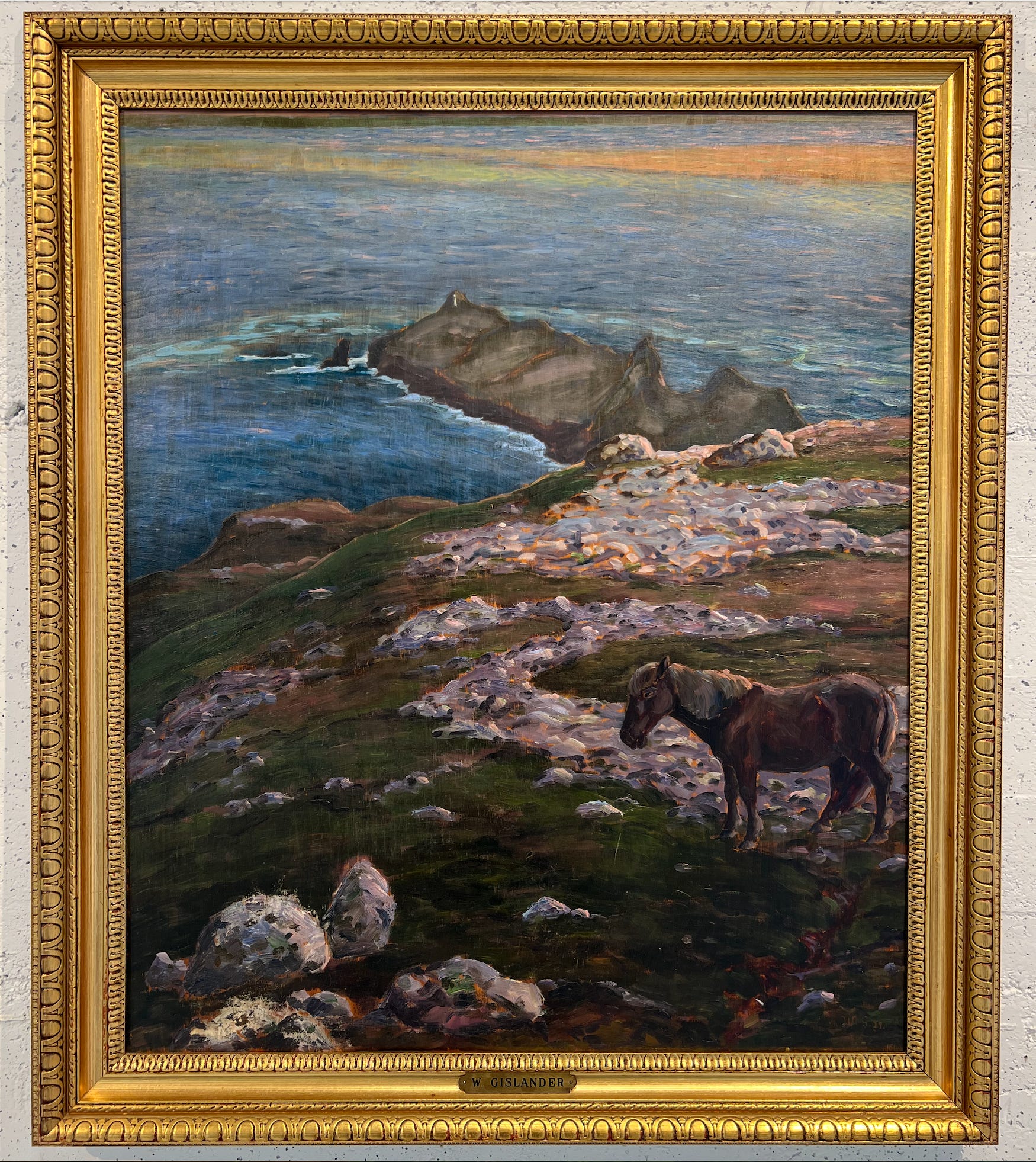
A brown horse with a bright mane stands besides the boulders.
The motif recalls another painting with the title “Evening Mood over the Mykenesfjäll” praised at the Copenhagen exhibition: “Two shaggy horses, typical of the islands, are seen grazing on the russet headland.”2
This painting shows a single animal. Still, it seems to belong to the same series of evening views that repeatedly drew Gislander onto the ridges above Mykines.
From their vantage points, he seems to have painted some of the strongest works of his career – paintings that the young Sámal Joensen Mikines later remembered as formative in his decision to become a painter.
The Lighthouse
Bogi and I move away from the concrete wall and sit on folding chairs beside the gallery window. After a while, we I agree, some of the darkness seems to lift and the colours begin to brighten.
“There’s something quite Impressionist about the horizon,” Bógi says.
Gislander did not consider himself a member of any particular school, calling himself a naturalist instead.3 Here, however, the subject seems to be light itself. Its shifts he described as one of the islands’ greatest fascinations.
As we let the impression of the painting sink in further, more features emerge: lit edges in the terrain catching nuances of the last light.
Then a single white mark catches my eye.
I point towards the Hólmur and turn to Bogi.
“There – he actually painted the lighthouse.”
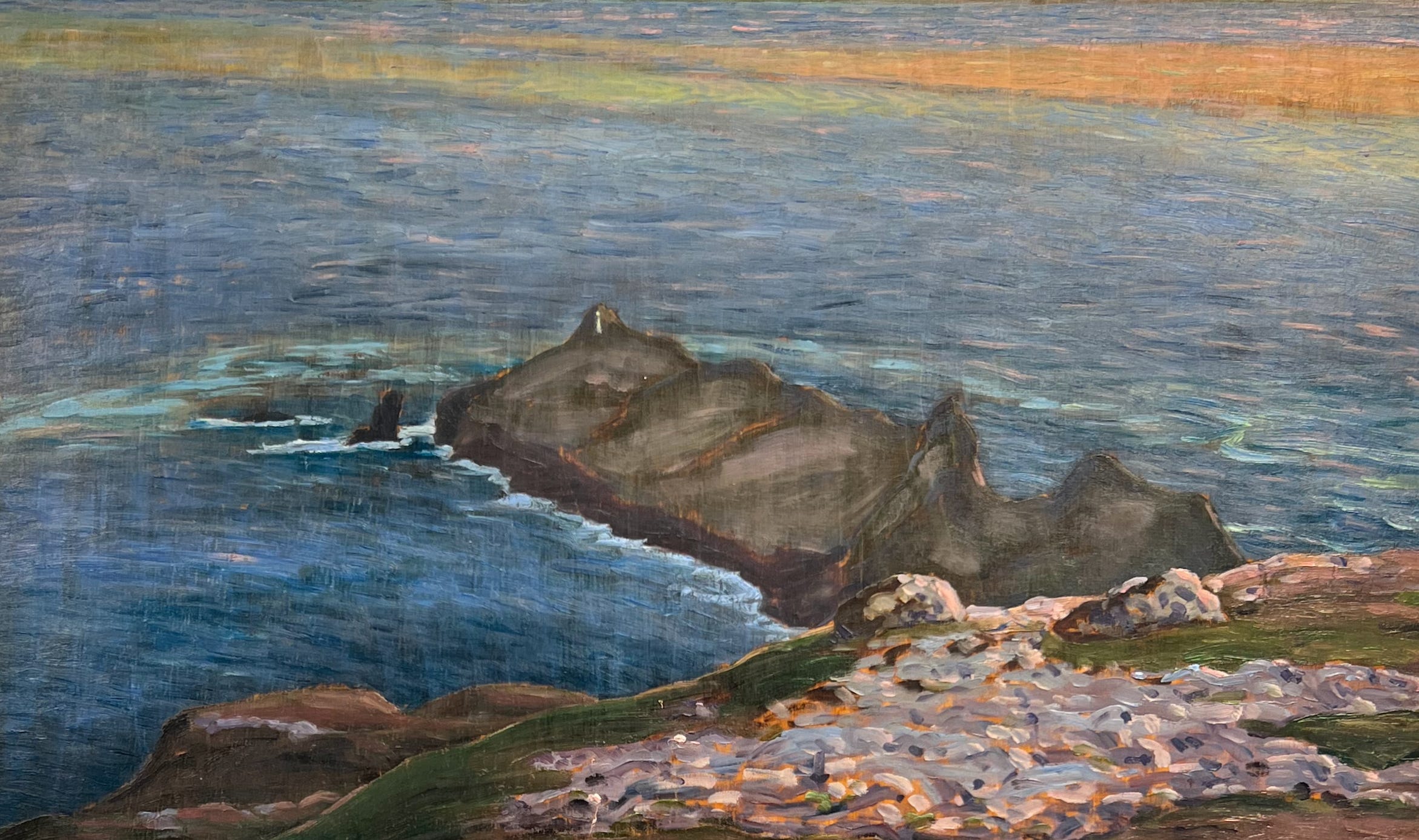
Gislander usually kept modern infrastructure outside his Faroese landscapes. That makes the white brushstroke on the Hólmur even more remarkable. The lighthouse was only fifteen years old in 1924. As far as my current research suggests, it is the only piece of man-made infrastructure he included in one of his Faroese painting.
The white brushstroke anchored another story, too.
I told Bogi about Knud Johannes Rohmann, the Danish dentist who travelled through the islands in 1924 and occasionally shared Gislander’s chartered boat. In early May, an attempt to reach Mykines had failed in the currents off Vágar. Rohmann returned to Tórshavn; Gislander continued alone.
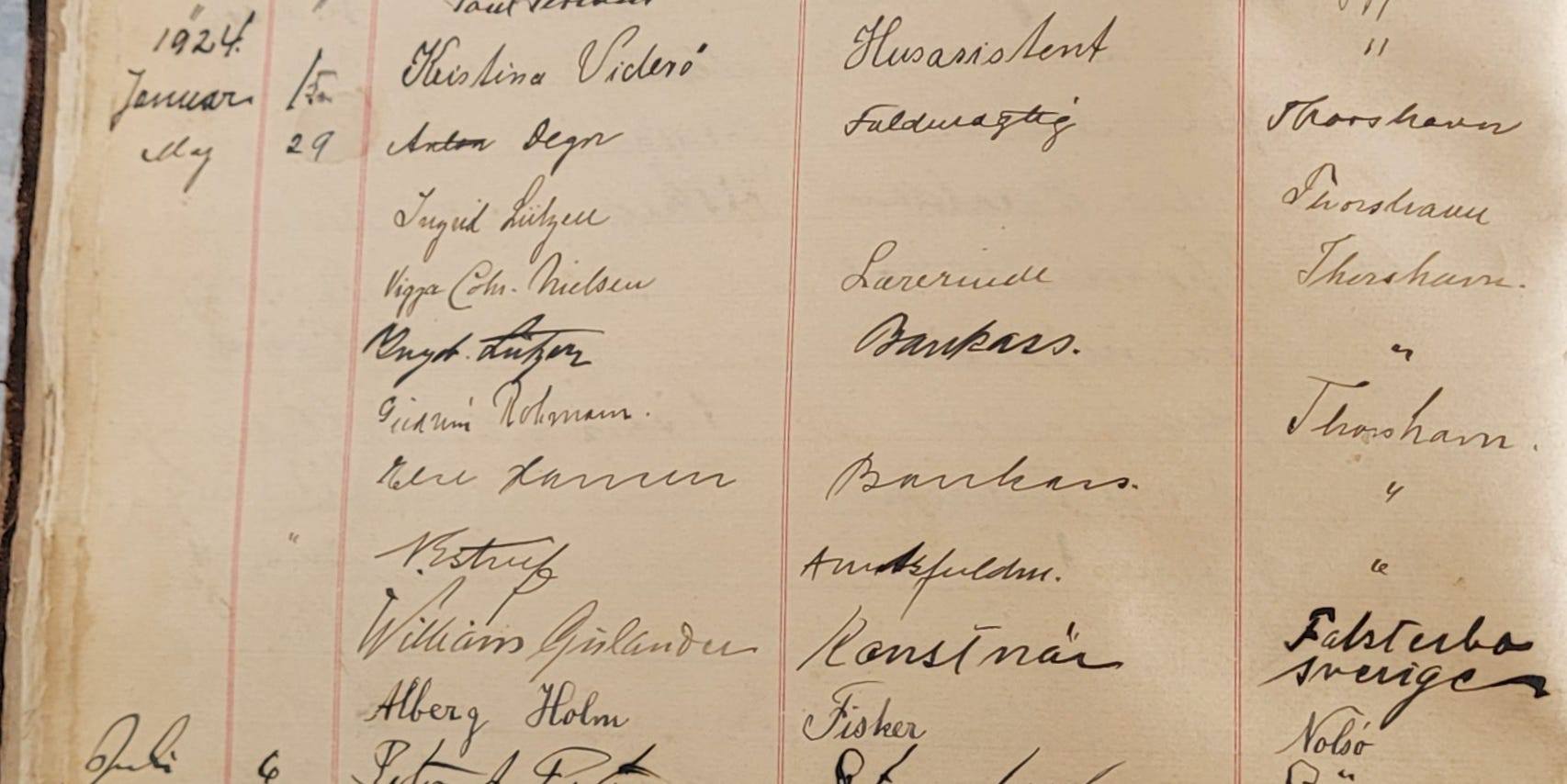
Rohmann finally reached Mykines later that month, on the day of Ascension. In a letter published by his local newspaper, he described walking with Gislander from the village across the breakneck hanging bridge to the Hólmur, descending to the gannet colony and then climbing to the lighthouse.
“There,” Rohmann wrote, “we left our names in the guestbook.”
A few years after the lighthouse, the house of its former keeper was built beneath the beacon represented by that white stroke. Heini Heinesen spent his childhood in that house; his father was one of the men who operated the lighthouse.
I had written to Heini about the guestbook Rohmann mentioned. A week after my visit to Gallerí Havnará, he replied.
He had crossed to the Hólmur to check in the meantime.
The visitor books from the 1920s are still there, he wrote.
Attached to Heini’s email were photographs of their pages. On 29 May 1924, a party from Tórshavn had entered their names. Rohmann was among them, signing himself as traveller with the nom de guerre “Gianni.”
Further below, in a hand I had known only from the lower-right corners of paintings, there was another name:
William Gislander.
Artist.
Falsterbo, Sweden.
Notes and Acknowledgments
I am grateful to Bogi Andreasen and Heini Heinesen for their support of my research.
See John Ruskin, Modern Painters, vol. 5, London 1897, p. 139 (online at archive.org).
Translated from Sydsvenska Dagbladet, 04.10.1924, p. 10.
See e.g. Nationaltidende, 29.09.1924, p. 4.
This article was produced with the financial assistance of the European Union. The views expressed herein can in no way be taken to reflect the official opinion of the European Union.
