

Gulls in the Stairwell
From a live radio conversation to a painting in a private home – and a new trace across the Atlantic.

After the Broadcast
Do you have time … now?
If you work with journalists, I’ve learned, you have to react quickly.
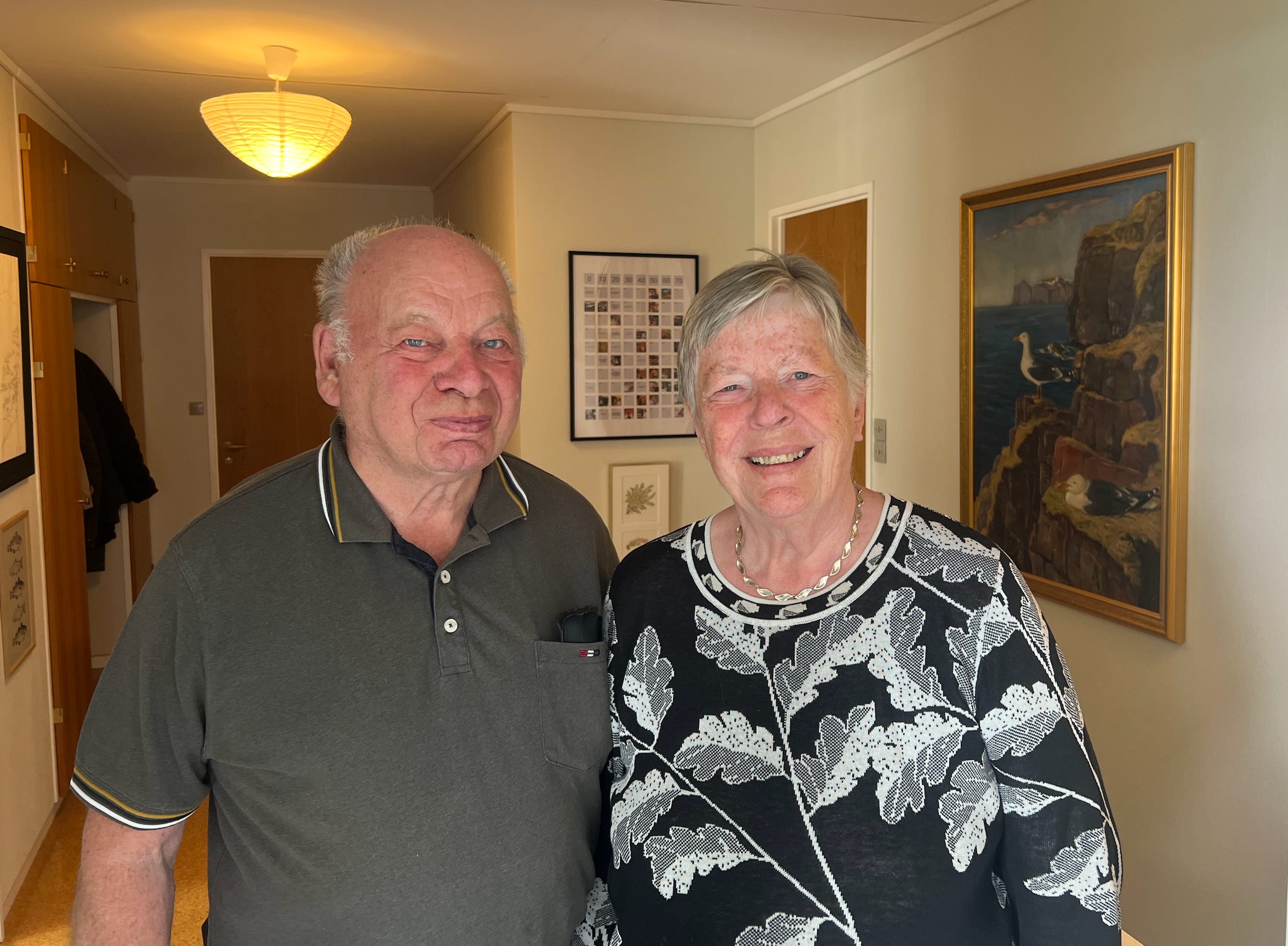
A few days after Ingi and Gunnar had hosted Solveig, director of Listasavn Føroya, and me on Summarmorgun, I called Ingi again. We had spoken live on national radio about the search for Gislander’s one hundred Faroese paintings from 1924 – many of them surviving in private homes. After the broadcast, Ingi had mentioned that one of them had belonged to his grandmother.
Five minutes after my call, I was sitting inside his electric car outside Listasavn. Soon, we hummed up onto the ring road above Tórshavn.
He spoke of the motif – a sea gull – when he first mentioned the painting. “She really liked the bird”, Ingi told me in the car.
“So your grandmother – she is still alive?”
“No, no,” he said. “She passed away in 2018 – Ingeborg. She actually turned 100.”
“Her father came from Fugloy, in the northern islands. His name was Jógvan Zachariassen. He was a doctor who practised in Klaksvík and later in Tórshavn, where he became the national doctor.”
“There was the story circulating in the family that Gislander stayed at their home when he was painting up in the north. He paid them with the painting, it was sometimes said. But who knows …”
The Mykines Gulls
A few minutes later, we pulled in at the house of his mother’s sister.
Anna Sofia and Hilbert welcomed us at the door. Already from the threshold, I spotted the painting over the stairwell down to the ground floor.
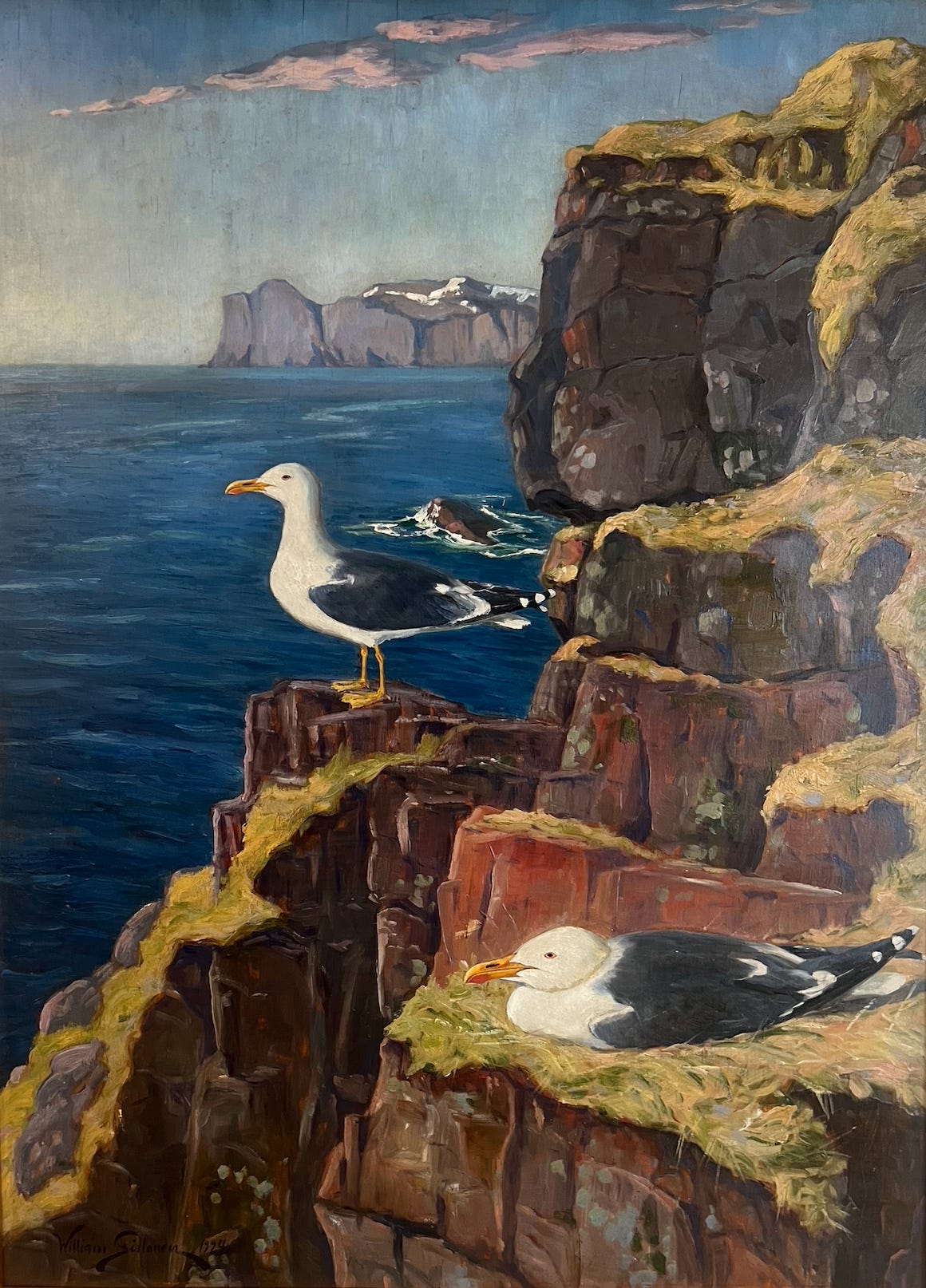
At first glance, the subject seemed simple enough: two Great Black-backed Gulls (Larus marinus), a rather common breeding bird on the Faroes. But the setting mattered more than the birds.
Gislander showed the gulls in a relatively large format placed among the rocks of Mykines. In the background rose the cliffs of Vestmanna; a view he had painted in several variations during his six weeks on the island (see no. 4 and no. 5 in the Search List).
Apparently, this was one of the approximately twenty paintings Gislander produced during his stay on Mykines in 1924.
A New Lead
“There may actually be another Gislander in the family, I think,” Ingi said. “My grandmother gave it to another of her daughters.”
“So that one’s also still on the islands?”
“No. It’s in Canada.”
“Canada?”
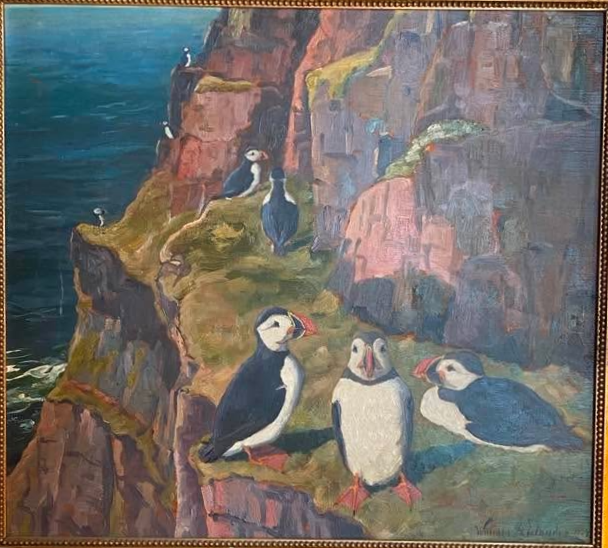
“Yes. Ontario. We have relatives there. It’s with puffins, I think.”
“Exciting – you know, Gislander’s puffins had a rather mixed reception in the reviews here in 1924.”
“Haha, yes …”
“Would be great to have an image in any case!” I said.
“Well, let me see what I can do ...”
In a way, this project had begun by following a trail from Southern Patagonia to the Faroe Islands, and to the painters who made their wildlife and landscapes visible in art. Unexpectedly, the trail now pointed across the Atlantic again.
It didn’t take long before the birds arrived from the other side.
The week after our trip to the gulls, Ingi forwarded me an image he had received from Canada. Judging from the photograph, it was a typical Gislander. Like the gull painting, it showed birds placed on the ledges of a cliff – this time puffins, seen from various angles.
A further piece of the Mykines puzzle had emerged, so it seemed.
Acknowledgments
I am grateful to Jens-Kjeld Jensen for confirming the identification of the gulls.
This article was produced with the financial assistance of the European Union. The views expressed herein can in no way be taken to reflect the official opinion of the European Union.
