

Miraculous Multiplications
Two Gislanders promised, three paintings discovered – and a new trail leading towards the Faroese coast.

The Promised Pair
“We got a mail for you,” Anna Maria from Listasavn said when I came into the office that morning. “Teitur wrote. He’s a local collector.”
“He says he has two Gislanders.”
The lecture and outreach campaign we had started the week before appeared to be working. The iron was hot, and I called Teitur immediately.
“It’s a bit tricky these days with my schedule,” he said, “but can you come … now?”
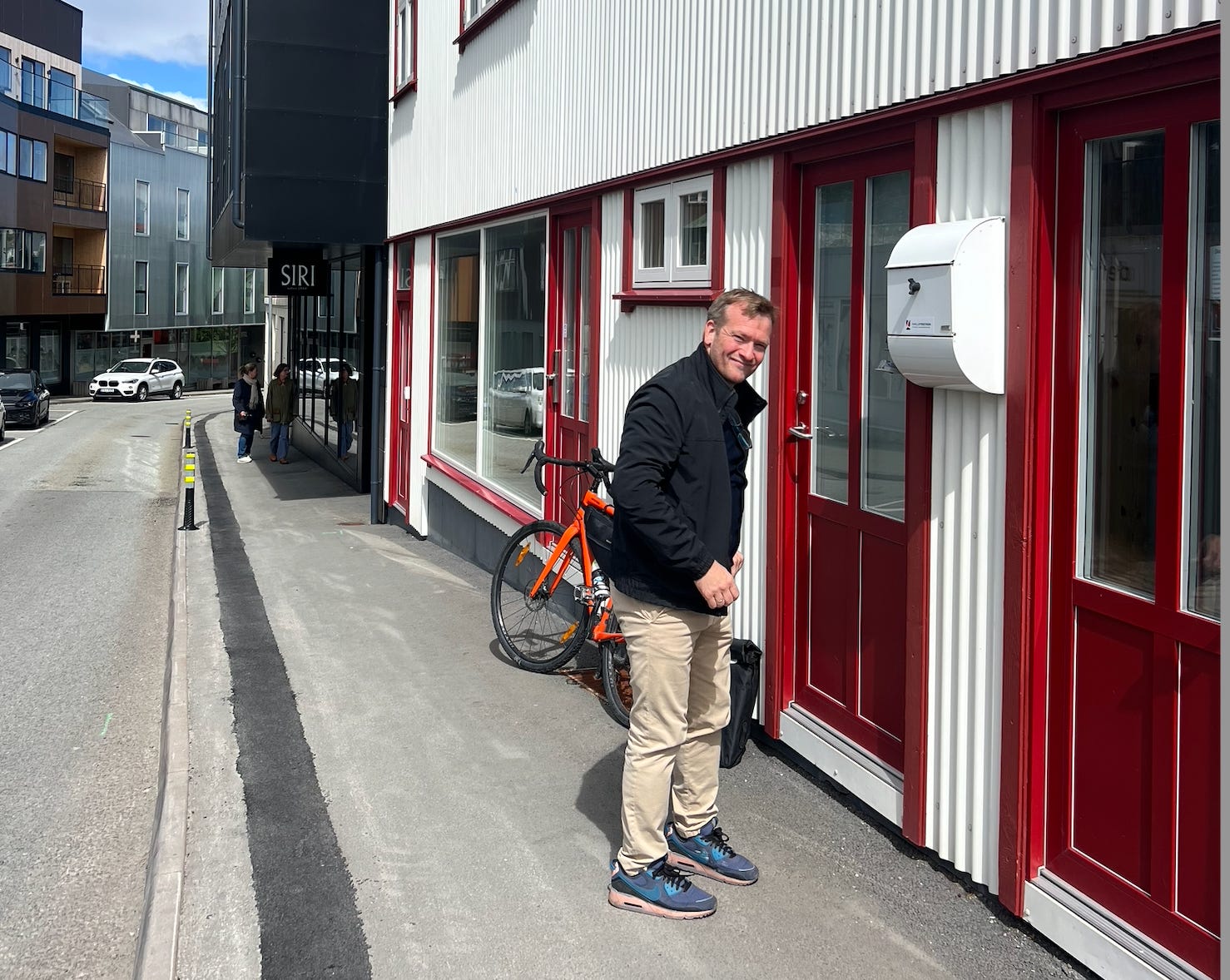
Ten minutes later, I got off my bike at an address in central Tórshavn. Teitur had made some room between meetings to show me his two Gislanders.
Harsh Weather
As we climbed to the first floor, Teitur explained that he had begun buying Faroese paintings early on. The apartment we entered had a period atmosphere – 1960s or 1970s, I guessed. Antique furniture decorated the rooms.
On the wall over the sofa, I spotted the first Gislander.
“Looks like another view he painted on the western coast of Streymoy,” I said.
I knew of different versions in which Gislander had painted agitated seascapes west of Kirkjubønes (see no. 15 in the Search List and the painting acquired by the Danish Parliament in 1924).
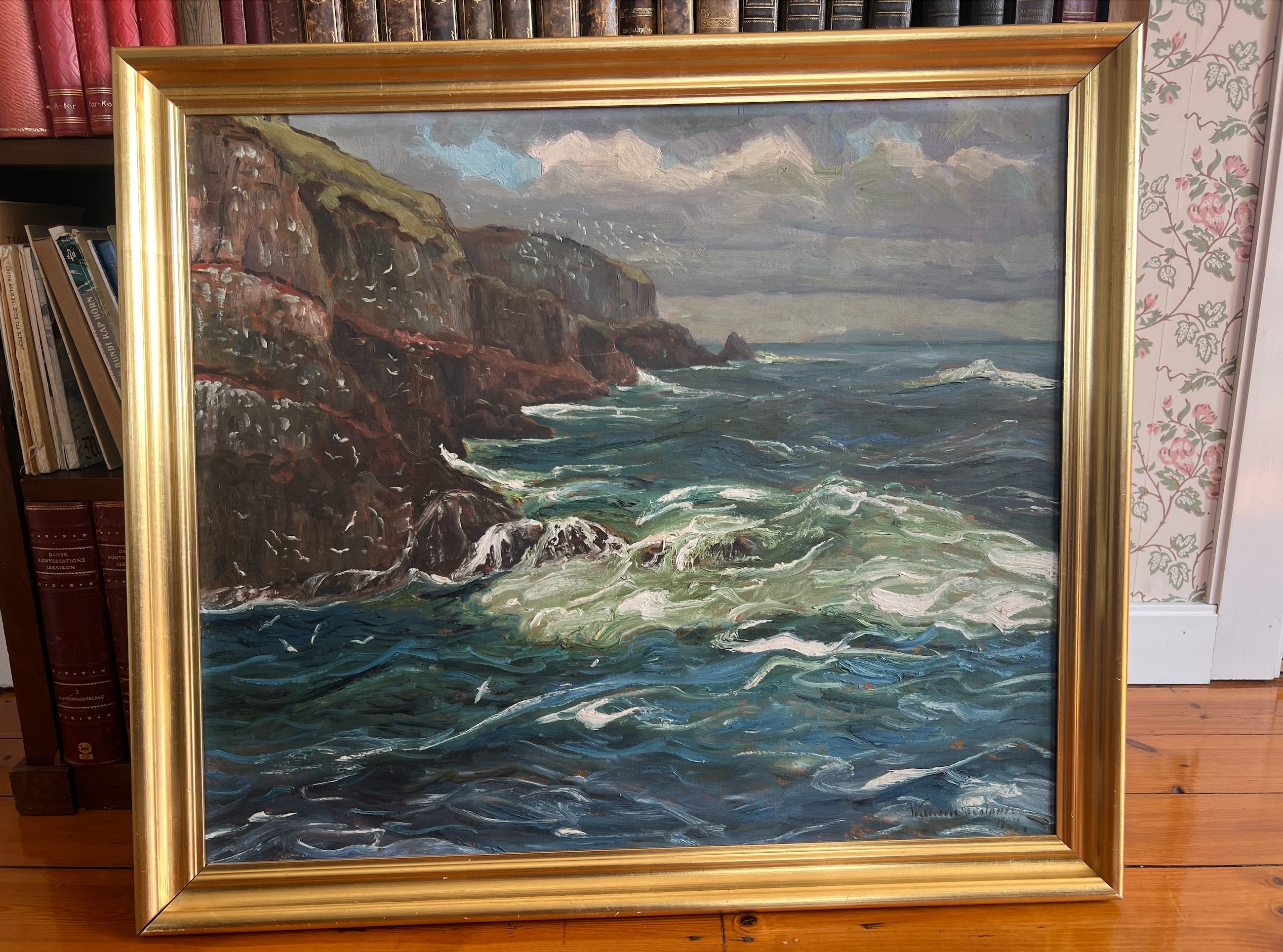
In this one, Gislander had rendered the water in remarkable colours. Shades of turquoise and aquamarine shimmer beneath windblown crests. Above, sunlight slips past the merlons of a wall of clouds, its underside glowing as if lit by a furnace blazing beyond the horizon.
A flight of guillemots seems to flee the infernal scene, towards a promontory that invades the background, looming like the head of a sperm whale breaking into the agitated sea.
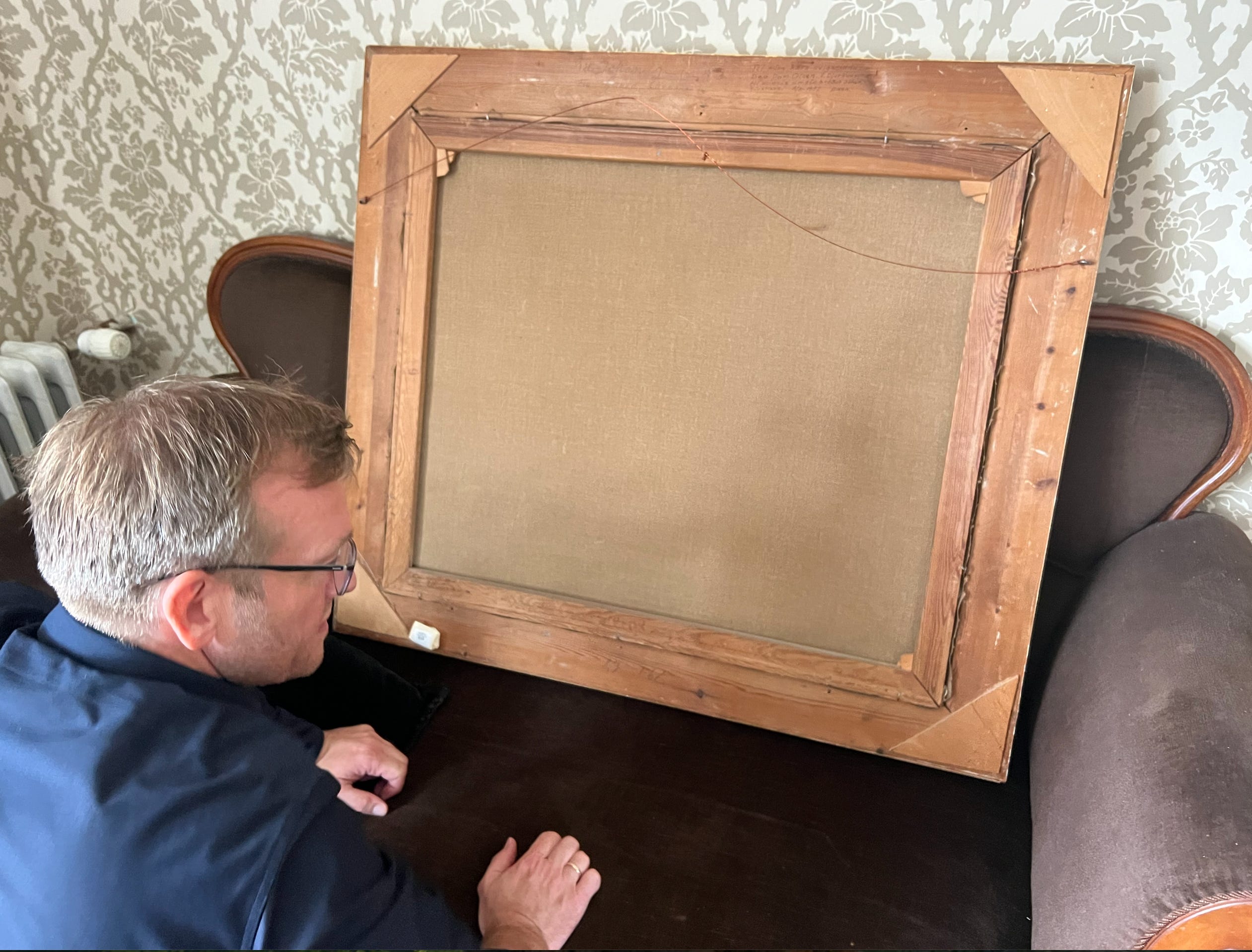
“Can I see the back and measure the frame?” I asked Teitur.
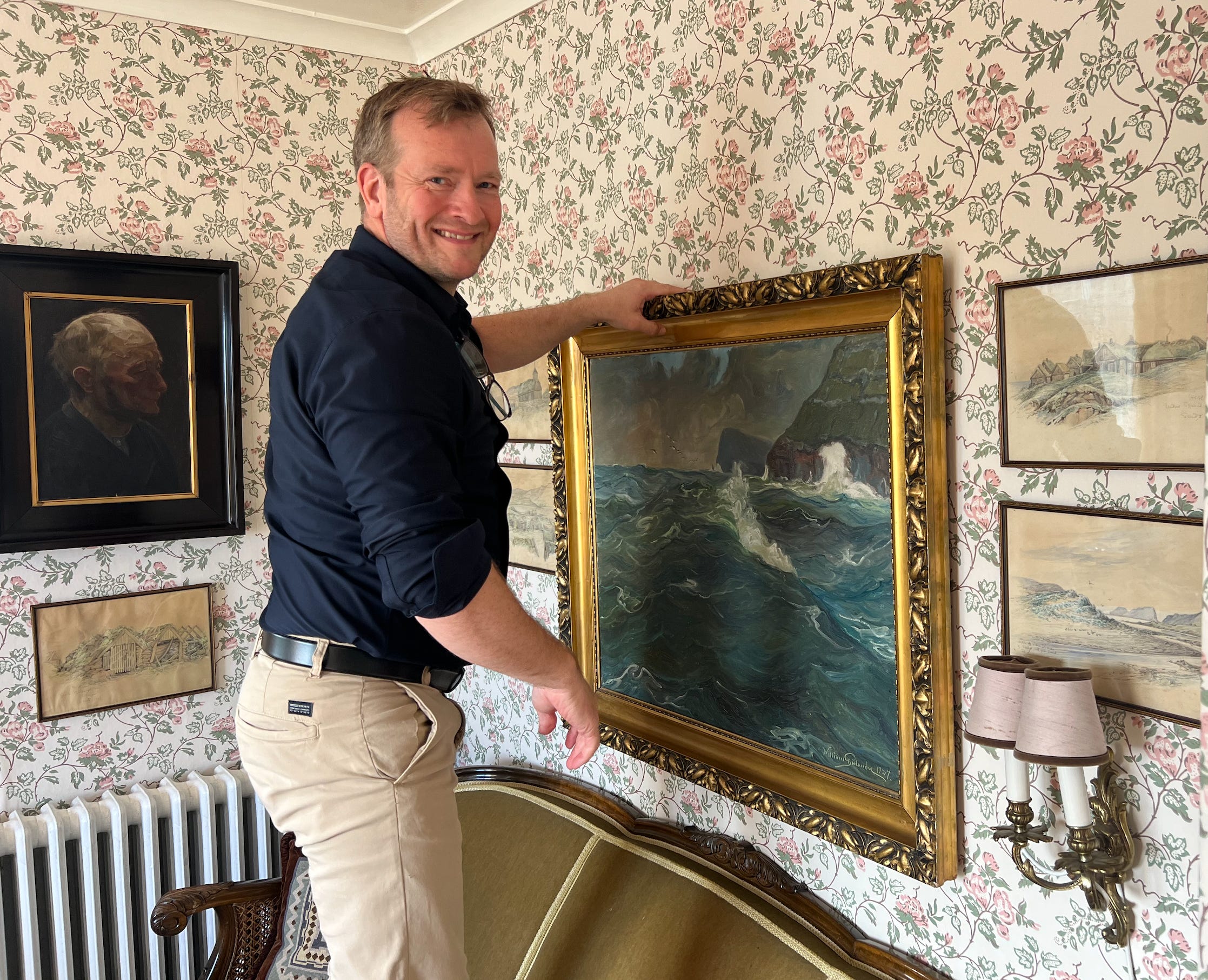
He took the painting down, placing it carefully on the sofa.
Handwritten notes ran all around the back of the frame. At the bottom, one seemed to preserve the original title: “Harsh Weather (from the West Coast of Streymoy, Faroe Islands – In the background: Dalsnypen / Dalsnýpa)”.1
The title named the promontory visible in the background – the ridge around Dalsnýpa, which Gislander had also painted from different angles, as I had learned.
A provenance chain unrolled all around the title, continuing to the top part of the frame. The dates spanned almost one century. Yet it was the bottom corners that caught our attention. To the right: “To my wife / 20 November 1928”. On the left: “From my beloved husband Oliver Effersø to my birthday 20–11–28.”
“That’s the brother of Rasmus, the politician!” Teitur said. “You’ve seen his statue down at the parliament, right?”
Mezzanine
“Shall we go and see the other one?” Teitur asked once I had closed my notebook and finished taking photographs.
On the floor above, he had said, was waiting the second Gislander.
Halfway up the stairs, I stopped.
“You know you have a third Gislander?” I asked.
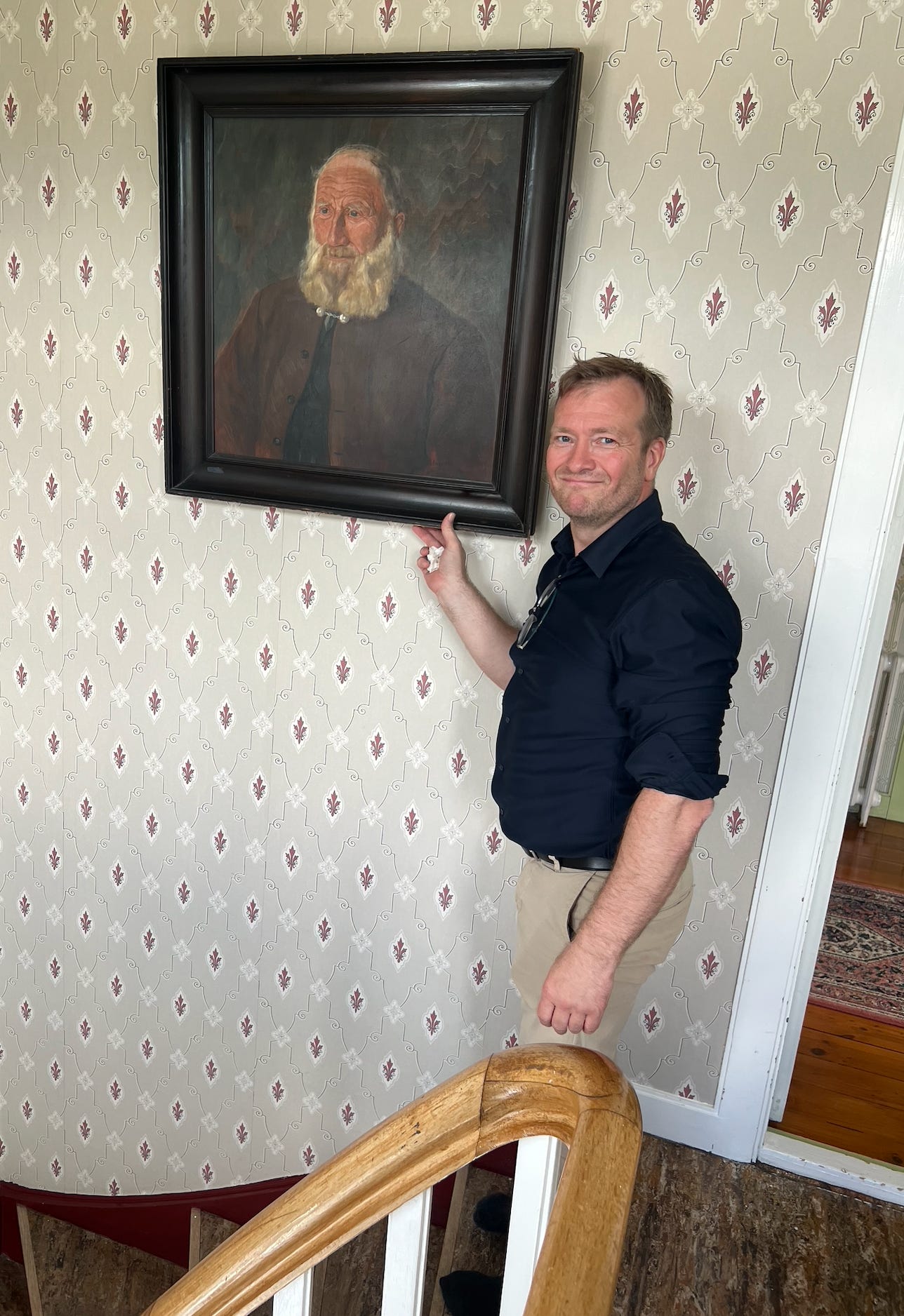
Teitur turned around. I pointed to a portrait hanging above our heads.
I had seen reproductions of this painting before – in newspapers from 1924 and in auction records. In interviews I had read, Gislander repeatedly referred to a single portrait he had painted on the islands – depicting ‘the old teacher Abrahamsen from Mykines’.
Until then, that trail had been tantalisingly incomplete. It ended in a 2021 auction record. Privacy regulations had brought the search to a halt.
By sheer accident, I now found myself face to face with the elusive portrait in a Tórshavn stairwell.
We leaned towards its lower-right corner. On the darkened surface, only a few letters of the painter’s signature were visible. In stronger light, however, the full name emerged: William Gislander.
By the time we reached the next painting, the arithmetic had already changed.
The Gislander waiting upstairs was now the third of the afternoon. Looser and more rapidly executed, it surrendered its story less readily than the other two. It depicted a sea view with bird cliffs – painted from a place still to be identified.
Somewhere beyond the apartment walls, another stretch of the Faroese coast was waiting to be found.
References
Original line in Danish: “William Gislander: Haardt Vejr / fra Vestkysten av Strømø, Færøerne – I Baggrunden: Dalsnypen, Dalsnýpa”.
The modern name Dalsnípa refers to a 341-metre-high peak as seen in the painting, with a steep drop on its far side (not to be confused with a place of the same name on Sándoy, which Darwin described as famous for minerals).
On Dalsnípa and the various renderings of the name, see Eivind Weyhe, Fjallanøvn í Føroyum, Tórshavn 2020, p. 49.
I am grateful to Jens Dam Ziska for his support in identifying the place names.